Short books under 200 pages, from an Irish farm to a living starship
Each of these runs under 200 pages in print. Read the first page and you have already read a fair slice of the book.

The first page of Foster
Early on a Sunday, after first Mass in Clonegal, my father, instead of taking me home, drives deep into Wexford towards the coast where my mother’s people came from. It is a hot day, bright, with patches of shade and greenish, sudden light along the road. We pass through the village of Shillelagh where my father lost our red Shorthorn in a game of forty-five, and on past the mart in Carnew where the man who won the heifer sold her shortly afterwards. My father throws his hat on the passenger seat, winds down the window, and smokes. I shake the plaits out of my hair and lie flat on the back seat, looking up through the rear window. In places there’s a bare, blue sky. In places the blue sky is chalked over with clouds, but mostly it is a heady mixture of sky and trees scratched over by ESB wires across which, every now and then, small, brownish flocks of vanishing birds race.
Continue reading
I wonder what it will be like, this place belonging to the Kinsellas. I see a tall woman standing over me, making me drink milk still hot from the cow. I see another, less likely version of her in an apron, pouring pancake batter onto a frying pan, asking would I like another, the way my mother sometimes does when she is in good humour. The man will be her size. He will take me to town on the tractor and buy me red lemonade and crisps. Or he’ll make me clean out sheds and pick stones and pull ragweed and docks out of the fields. I see him pulling what I hope will be a fifty-pence piece from his pocket but it turns out to be a handkerchief. I wonder if they live in an old farmhouse or a new bungalow, whether they will have an outhouse or an indoor bathroom with a toilet and running water. I picture myself lying in a dark bedroom with other girls, saying things we won’t repeat when morning comes.
An age, it seems, passes before the car slows and turns into a tarred, narrow lane, then a thrill as the wheels slam over the metal bars of a cattle grid. On either side, thick hedges are trimmed square. At the end of the lane there’s a long, white house with trees whose limbs are trailing the ground.
‘Da,’ I say. ‘The trees.’
‘What about ’em?’
‘They’re sick,’ I say.
‘They’re weeping willows,’ he says, and clears his throat.
In the yard, tall, shiny panes reflect our coming. I see myself looking out from the back seat wild as a tinker’s child with my hair all loose but my father, at the wheel, looks just like my father. A big, loose hound whose coat is littered with the shadows of the trees lets out a few rough, half-hearted barks, then sits on the step and looks back at the doorway where the man has come out to stand. He has a square body like the men my sisters sometimes draw, but his eyebrows are white, to match his hair. He looks nothing like my mother’s people, who are all tall with long arms, and I wonder if we have not come to the wrong house.
‘Dan,’ he says, and tightens himself. ‘What way are you?’
‘John,’ Da says.
“A heartbreaking but deeply humane story about parents and children.”
Kirkus Reviews

The first page of Binti
I powered up the transporter and said a silent prayer. I had no idea what I was going to do if it didn't work. My transporter was cheap, so even a droplet of moisture, or more likely, a grain of sand, would cause it to short. It was faulty and most of the time I had to restart it over and over before it worked. Please not now, please not now, I thought.
The transporter shivered in the sand and I held my breath. Tiny, flat, and black as a prayer stone, it buzzed softly and then slowly rose from the sand. Finally, it produced the baggage-lifting force. I grinned. Now I could make it to the shuttle. I swiped otjize from my forehead with my index finger and knelt down. Then I touched the finger to the sand, grounding the sweet smelling red clay into it. “Thank you,” I whispered. It was a half-mile walk along the dark desert road. With the transporter working, I would make it there on time.
Continue reading
Straightening up, I paused and shut my eyes. Now the weight of my entire life was pressing on my shoulders. I was defying the most traditional part of myself for the first time in my entire life. I was leaving in the dead of night and they had no clue. My nine siblings, all older than me except for my younger sister and brother, would never see this coming. My parents would never imagine I’d do such a thing in a million years. By the time they all realized what I’d done and where I was going, I’d have left the planet. In my absence, my parents would growl to each other that I was to never set foot in their home again. My four aunties and two uncles who lived down the road would shout and gossip among themselves about how I’d scandalized our entire bloodline. I was going to be a pariah.
“Go,” I softly whispered to the transporter, stamping my foot. The thin metal rings I wore around each ankle jingled noisily, but I stamped my foot again. Once on, the transporter worked best when I didn’t touch it. “Go,” I said again, sweat forming on my brow. When nothing moved, I chanced giving the two large suitcases sitting atop the force field a shove. They moved smoothly and I breathed another sigh of relief. At least some luck was on my side.
~
Fifteen minutes later I purchased a ticket and boarded the shuttle. The sun was barely beginning to peak over the horizon.
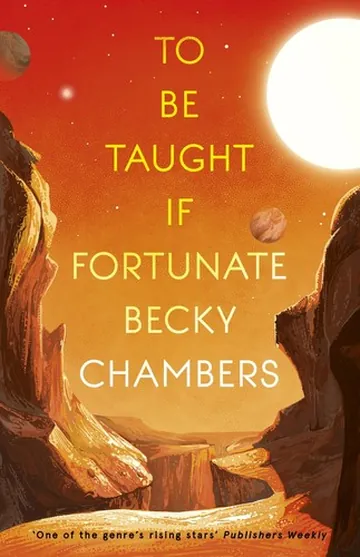
The first page of To Be Taught, If Fortunate
If you read nothing else we've sent home, please at least read this. I ask knowing full well that this request is antithetical to what I believe in my heart of hearts. Our mission reports contain our science, and the science is by far the most important thing here. My crew and I are a secondary concern. Tertiary, even.
But all the same, we do have a lot riding on someone picking this up.
You don't have to rush. This file will have taken fourteen years to reach Earth, and assuming that we have the good luck of someone reading it right away and replying straight after, it'd take that file another fourteen years. So, while we can't wait around forever, the urgency – like so many things in space travel – is relative. You could, I suppose, skip right to the end. You wouldn't be the first person to do such a thing, and honestly, that's where the bit that affects us most will be laid out.
Continue reading
And maybe, if you already know who we are and what we're about if you're someone who sent us here, perhaps you can do that and still understand. But even if that's the case, I do think the why of what we need from you is important. I'm biased, of course, and doubly so: Not only is this account about me and my crew, but we're scientists. We live and breathe why. It's been fifty years since we left Earth, and I don't know whose eyes or ears this message has reached. I know how much a world can change within the bookends of a lifetime. Causes shift and memories blur. I also don't know how much you personally know of the universe beyond our home planet. Perhaps you're one of the knowledgeable sorts I've already mentioned, who can rattle off spaceflight history better than even I can and who shares the same goals as me. Or perhaps you're someone who lives outside my bubble. Perhaps this is all new to you. When I use words like 'exoplanet' or 'red dwarf,' do you know what I mean? This is not a test, and I absolutely do not judge if terms such as these mean nothing to you. On the contrary, I want to speak to you as much as I want to speak to my peers maybe even more so. If I ask what I'm asking only of people who agree with me at the outset, with whom I already share a dream and a language, then there's no point in asking at all.
For this reason, I’ll do my best to speak to expert and novice both. I likewise feel it important to start from the beginning, so that the context of our situation is clear. I doubt what I write will be objective. I will almost certainly contradict myself.
I do promise that I’ll tell you the truth.
My name is Ariadne O’Neill, and I’m the flight engineer aboard the OCA spacecraft Merian. My crewmates are mission specialists Elena Quesada-Cruz, Jack Vo, and Chikondi Daka. We’re part of the Lawki program, a broad ecological survey of exoplanets – that is, planets that do not orbit our sun – known or suspected to harbour life. Our mission (Lawki 6) is focused on the four habitable worlds in orbit around the red dwarf star Zhenyi (BA-921): the icy moon Aecor, and the terrestrial planets Mirabilis, Opera, and Votum. I’m currently stationed on the surface of the last on that list.
I was born in Cascadia on July 13, 2081. On that day, it had been fifty-five years, eight months, and nine days since a human being had been in space. I was the two-hundred-and-fourth person to go back, and part of the sixth extrasolar crew. I’m writing to you in the hope that we will not be the last.
“An extraordinary picture of humanity among the stars.”
Kirkus Reviews
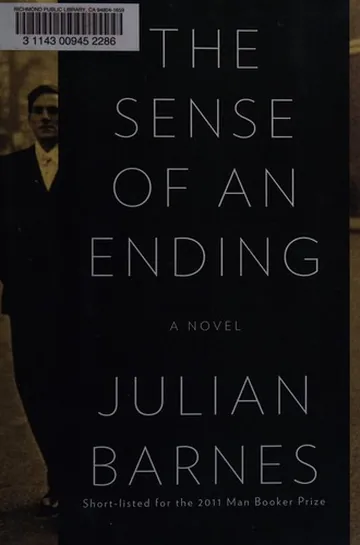
The first page of The Sense of an Ending
I remember, in no particular order: —a shiny inner wrist; —steam rising from a wet sink as a hot frying pan is laughingly tossed into it; —gouts of sperm circling a plughole, before being sluiced down the full length of a tall house; —a river rushing nonsensically upstream, its wave and wash lit by half a dozen chasing torchbeams; —another river, broad and grey, the direction of its flow disguised by a stiff wind exciting the surface; —bathwater long gone cold behind a locked door. This last isn't something I actually saw, but what you end up remembering isn't always the same as what you have witnessed.
We live in time—it holds us and moulds us—but I've never felt I understood it very well. And I’m not referring to theories about how it bends and doubles back, or may exist elsewhere in parallel versions. No, I mean ordinary, everyday time, which clocks and watches assure us passes regularly: tick-tock, click-clock. Is there anything more plausible than a second hand? And yet it takes only the smallest pleasure or pain to teach us time’s malleability. Some emotions speed it up, others slow it down; occasionally, it seems to go missing—until the eventual point when it really does go missing, never to return. I’m not very interested in my schooldays, and don’t feel any nostalgia for them. But school is where it all began, so I need to return briefly to a few incidents that have grown into anecdotes, to some approximate memories which time has deformed into certainty. If I can’t be sure of the actual events any more, I can at least be true to the impressions those facts left. That’s the best I can manage.
Continue reading
There were three of us, and he now made the fourth. We hadn’t expected to add to our tight number: cliques and pairings had happened long before, and we were already beginning to imagine our escape from school into life. His name was Adrian Finn, a tall, shy boy who initially kept his eyes down and his mind to himself. For the first day or two, we took little notice of him: at our school there was no welcoming ceremony, let alone its opposite, the punitive induction. We just registered his presence and waited. The masters were more interested in him than we were. They had to work out his intelligence and sense of discipline, calculate how well he’d previously been taught, and if he might prove “scholarship material.” On the third morning of that autumn term, we had a history class with Old Joe Hunt, wryly affable in his three-piece suit, a teacher whose system of control depended on maintaining sufficient but not excessive boredom. “Now, you’ll remember that I asked you to do some preliminary reading about the reign of Henry the Eighth.” Colin, Alex and I squinted at one another, hoping that the question wouldn’t be flicked, like an angler’s fly, to land on one of our heads. “Who might like to offer a characterisation of the age?” He drew his own conclusion from our averted eyes. “Well, Marshall, perhaps. How would you describe Henry the Eighth’s reign?” Our relief was greater than our curiosity, because Marshall was a cautious know-nothing who lacked the inventiveness of true ignorance. He searched for possible hidden complexities in the question before eventually locating a response. “There was unrest, sir.” An outbreak of barely controlled smirking; Hunt himself almost smiled.
“From the haunting images of its first pages to the surprising and wrenching finale…”
Publishers Weekly

The first page of Sula
In that place, where they tore the nightshade and blackberry patches from their roots to make room for the Medallion City Golf Course, there was once a neighborhood. It stood in the hills above the valley town of Medallion and spread all the way to the river. It is called the suburbs now, but when black people lived there it was called the Bottom. One road, shaded by beeches, oaks, maples and chestnuts, connected it to the valley. The beeches are gone now, and so are the pear trees where children sat and yelled down through the blossoms to passersby. Generous funds have been allotted to level the stripped and faded buildings that clutter the road from Medallion up to the golf course. They are going to raze the Time and a Half Pool Hall, where feet in long tan shoes once pointed down from chair rungs. A steel ball will knock to dust Irene’s Palace of Cosmetology, where women used to lean their heads back on sink trays and doze while Irene lathered Nu Nile into their hair. Men in khaki work clothes will pry loose the slats of Reba’s Grill, where the owner cooked in her hat because she couldn’t remember the ingredients without it.
Continue reading
There will be nothing left of the Bottom (the footbridge that crossed the river is already gone), but perhaps it is just as well, since it wasn’t a town anyway: just a neighborhood where on quiet days people in valley houses could hear singing sometimes, banjos sometimes, and, if a valley man happened to have business up in those hills—collecting rent or insurance payments—he might see a dark woman in a flowered dress doing a bit of cakewalk, a bit of black bottom, a bit of “messing around” to the lively notes of a mouth organ. Her bare feet would raise the saffron dust that floated down on the coveralls and bunion-split shoes of the man breathing music in and out of his harmonica. The black people watching her would laugh and rub their knees, and it would be easy for the valley man to hear the laughter and not notice the adult pain that rested somewhere under the eyelids, somewhere under their head rags and soft felt hats, somewhere in the palm of the hand, somewhere behind the frayed lapels, somewhere in the sinew’s curve. He’d have to stand in the back of Greater Saint Matthew’s and let the tenor’s voice dress him in silk, or touch the hands of the spoon carvers (who had not worked in eight years) and let the fingers that danced on wood kiss his skin. Otherwise the pain would escape him even though the laughter was part of the pain. A shucking, knee-slapping, wet-eyed laughter that could even describe and explain how they came to be where they were.
A joke. A nigger joke. That was the way it got started. Not the town, of course, but that part of town where the Negroes lived, the part they called the Bottom in spite of the fact that it was up in the hills. Just a nigger joke. The kind white folks tell when the mill closes down and they’re looking for a little comfort somewhere.
Content note: racial slur, child death
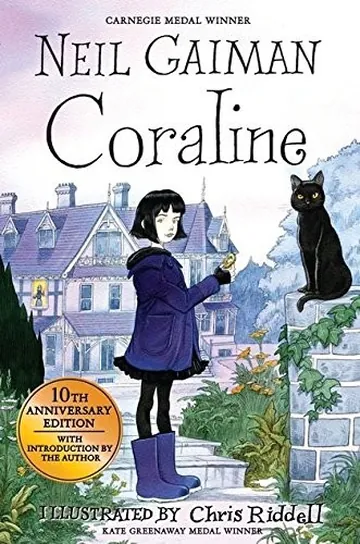
The first page of Coraline
Coraline discovered the door a little while after they moved into the house.
It was a very old house – it had an attic under the roof and a cellar under the ground and an overgrown garden with huge old trees in it.
Coraline's family didn't own all of the house, it was too big for that. Instead they owned part of it.
There were other people who lived in the old house.
Miss Spink and Miss Forcible lived in the flat below Coraline's, on the ground floor. They were both old and round, and they lived in their flat with a number of ageing Highland terriers who had names like Hamish and Andrew and Jock. Once upon a time Miss Spink and Miss Forcible had been actresses, as Miss Spink told Coraline the first time she met her.
‘You see, Caroline,’ Miss Spink said, getting Coraline’s name wrong, ‘both myself and Miss Forcible were famous actresses, in our time. We trod the boards, lovey. Oh, don’t let Hamish eat the fruitcake, or he’ll be up all night with his tummy.’
Continue reading
‘It’s Coraline. Not Caroline. Coraline,’ said Coraline.
In the flat above Coraline’s, under the roof, was a crazy old man with a big moustache. He told Coraline that he was training a mouse circus. He wouldn’t let anyone see it.
‘One day, little Caroline, when they are all ready, everyone in the whole world will see the wonders of my mouse circus. You ask me why you cannot see it now. Is that what you asked me?’
‘No,’ said Coraline quietly, ‘I asked you not to call me Caroline. It’s Coraline.’
‘The reason you cannot see the mouse circus,’ said the man upstairs, ‘is that the mice are not yet ready and rehearsed. Also, they refuse to play the songs I have written for them. All the songs I have written for the mice to play go oompah oompah. But the white mice will only play toodle oodle, like that. I am thinking of trying them on different types of cheese.’
Coraline didn’t think there really was a mouse circus. She thought the old man was probably making it up.
The day after they moved in, Coraline went exploring.
She explored the garden. It was a big garden: at the very back was an old tennis court, but no one in the house played tennis and the fence around the court had holes in it and the net had mostly rotted away; there was an old rose garden, filled with stunted, flyblown rose bushes; there was a rockery that was all rocks; there was a fairy ring, made of squidgy brown toadstools which smelled dreadful if you accidentally trod on them.
There was also a well. On the first day Coraline’s family moved in, Miss Spink and Miss Forcible made a point of telling Coraline how dangerous the well was, and they warned her to be sure she kept away from it. So Coraline set off to explore for it, so that she knew where it was, to keep away from it properly.
She found it on the third day, in an overgrown meadow beside the tennis court, behind a clump of trees - a low brick circle almost hidden in the high grass. The well had been covered over by wooden boards, to stop anyone falling in.
“…a sure sense of a child’s fears…”
Kirkus Reviews

The first page of A Pale View of Hills
Niki, the name we finally gave my younger daughter, is not an abbreviation; it was a compromise I reached with her father. For paradoxically it was he who wanted to give her a Japanese name, and I — perhaps out of some selfish desire not to be reminded of the past — insisted on an English one. He finally agreed to Niki, thinking it had some vague echo of the East about it.
She came to see me earlier this year, in April, when the days were still cold and drizzly. Perhaps she had intended to stay longer, I do not know. But my country house and the quiet that surrounds it made her restless, and before long I could see she was anxious to return to her life in London. She listened impatiently to my classical records, flicked through numerous magazines. The telephone rang for her regularly, and she would stride across the carpet, her thin figure squeezed into her tight clothes, taking care to close the door behind her so I would not overhear her conversation. She left after five days.
Continue reading
She did not mention Keiko until the second day. It was a grey windy morning, and we had moved the armchairs nearer the windows to watch the rain falling on my garden.
“Did you expect me to be there?” she asked. “At the funeral, I mean.”
“No, I suppose not. I didn’t really think you’d come.”
“It did upset me, hearing about her. I almost came.”
“I never expected you to come.”
“People didn’t know what was wrong with me,” she said. “I didn’t tell anybody. I suppose I was embarrassed. They wouldn’t understand really, they wouldn’t understand how I felt about it. Sisters are supposed to be people you’re close to, aren’t they. You may not like them much, but you’re still close to them. That’s just not how it was though. I don’t even remember what she looked like now.”
“Yes, it’s quite a time since you saw her.”
“I just remember her as someone who used to make me miserable. That’s what I remember about her. But I was sad though, when I heard.”
Perhaps it was not just the quiet that drove my daughter back to London. For although we never dwelt long on the subject of Keiko’s death, it was never far away, hovering over us whenever we talked.
Keiko, unlike Niki, was pure Japanese, and more than one newspaper was quick to pick up on this fact. The English are fond of their idea that our race has an instinct for suicide, as if further explanations are unnecessary; for that was all they reported, that she was Japanese and that she had hung herself in her room.
*
That same evening I was standing at the windows, looking out into the darkness, when I heard Niki say behind me; “What are you thinking about now, Mother?” She was sitting across the settee, a paperback book on her knee.
“I was thinking about someone I knew once. A woman I knew once.”
“Someone you knew when you ... before you came to England?”
“I knew her when I was living in Nagasaki, if that’s what you mean.” She continued to watch me, so I added: “A long time ago. Long before I met your father.”
She seemed satisfied and with some vague comment returned to her book. In many ways Niki is an affectionate child. She had not come simply to see how I had taken the news of Keiko’s death; she had come to me out of a sense of mission. For in recent years she has taken it upon herself to admire certain aspects of my past, and she had come prepared to tell me things were no different now, that I should have no regrets for those choices I once made.
Questions
Quick answers
How long is each one?
Page counts vary by edition. Foster and Binti are novellas of little more than 100 pages; the longest here, A Pale View of Hills, runs about 190.