Books set in London, from Regency Newgate to the city in 2059
Novels set in London, from a cobbler’s daughter in 1752 to Denmark Street, a body in West London, a boy new to Holloway and the Scion city of 2059. One of them moves between several Londons.
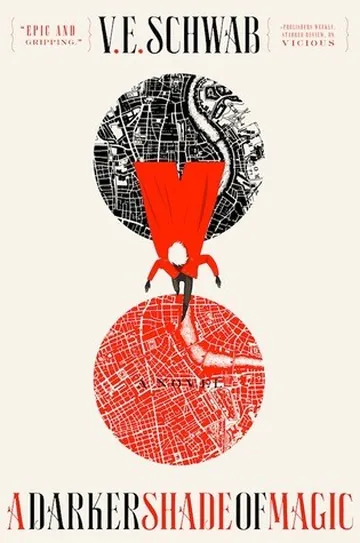
The first page of A Darker Shade of Magic
Kell wore a very peculiar coat. It had neither one side, which would be conventional, nor two, which would be unexpected, but several, which was, of course, impossible. The first thing he did whenever he stepped out of one London and into another was take off the coat and turn it inside out once or twice (or even three times) until he found the side he needed. Not all of them were fashionable, but they each served a purpose. There were ones that blended in and ones that stood out, and one that served no purpose but of which he was just particularly fond.
So when Kell passed through the palace wall and into the anteroom, he took a moment to steady himself—it took its toll, moving between worlds—and then shrugged out of his red, high-collared coat and turned it inside out from right to left so that it became a simple black jacket. Well, a simple black jacket elegantly lined with silver thread and adorned with two gleaming columns of silver buttons. Just because he adopted a more modest palette when he was abroad (wishing neither to offend the local royalty nor to draw attention) didn’t mean he had to sacrifice style.
Continue reading
Oh, kings, thought Kell as he fastened the buttons on the coat. He was starting to think like Rhy.
On the wall behind him, he could just make out the ghosted symbol made by his passage. Like a footprint in sand, already fading.
He’d never bothered to mark the door from this side, simply because he never went back this way. Windsor’s distance from London was terribly inconvenient considering the fact that, when traveling between worlds, Kell could only move between a place in one and the same exact place in another. Which was a problem because there was no Windsor Castle a day’s journey from Red London. In fact, Kell had just come through the stone wall of a courtyard belonging to a wealthy gentleman in a town called Disan. Disan was, on the whole, a very pleasant place. Windsor was not.
Impressive, to be sure. But not pleasant.
A marble counter ran against the wall, and on it a basin of water waited for him, as it always did. He rinsed his bloody hand, as well as the silver crown he’d used for passage, then slipped the cord it hung on over his head, and tucked the coin back beneath his collar. In the hall beyond, he could hear the shuffle of feet, the low murmur of servants and guards. He’d chosen the anteroom specifically to avoid them. He knew very well how little the Prince Regent liked him being here, and the last thing Kell wanted was an audience, a cluster of ears and eyes and mouths reporting the details of his visit back to the throne.
Above the counter and the basin hung a mirror in a gilded frame, and Kell checked his reflection quickly—his hair, a reddish brown, swept down across one eye, and he did not fix it, though he did take a moment to smooth the shoulders of his coat—before passing through a set of doors to meet his host.
The room was stiflingly warm—the windows latched despite what looked like a lovely October day—and a fire raged oppressively in the hearth.
“…an ingenious set of nesting alternate Londons in this imaginative, well-crafted fantasy.”
Publishers Weekly
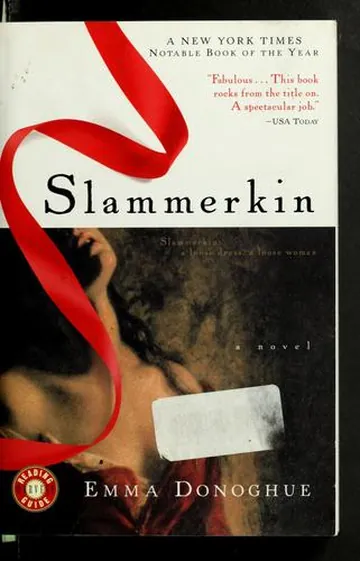
The first page of Slammerkin
There once was a cobbler called Saunders who died for eleven days. At least, that was how his daughter remembered it.
In the year 1752 it was announced that the second of September would be followed by the fourteenth. The matter was merely one of wording, of course; time in its substance was not to undergo any change. Since this calendrical reform would bring the kingdom of Great Britain in line with its neighbours at last, what price a brief inconvenience, a touch of confusion? London newspapers printed witty verses about the ‘Annihilation of Time,' but no one doubted the Government’s weighty reasons. Nor did anyone think to explain them to persons of no importance, such as Cob Saunders.
He knew this much: injustice had been done. There were eleven days of chiselling shoe leather he’d never be paid for, eleven dinners snatched away before they reached his lips, eleven nights when he was going to be cheated out of the sweet relief of dropping down on his straw mattress.
Continue reading
On September the fourteenth—New Style, as they called it—Cob Saunders woke up with a hammering head and knew that eleven days of his life had been lost. Stolen, rather; cut out of his allotted span the way you might nick a wormhole out of an apple. He had no notion how those days had been done away with, or how he might fetch them back; his head was fit to split when he tried to figure it out. He was a man eleven days nearer to his death and there was nothing he could do.
But perhaps there was. When the Calendar Riots began—though Cob had no part in the starting of them—he joined in with all the breath he had, tossing his rage onto the general bonfire. The cry went up: Give us back our eleven days.
The Government was merciful; Cob Saunders wasn’t executed. He died of gaol fever.
Christmas came eleven days early, that year. The clamour of church bells pulled the air as taut as catgut, and the cobbler’s five-year-old daughter Mary knelt below the window, watching for snow that never fell.
Eleven years later Mary Saunders was back on her knees, herself in gaol.
Like father, like daughter.
The night room in Monmouth Gaol was twenty-two feet long and fifteen feet wide. She’d measured it by pacing, her first night. Four walls and no windows: here the men and women awaiting trial at the Spring Sessions lived like rats. Some were chained up after sunset, but not necessarily the murderers; there was no rhyme or reason to it that Mary could see. Anything, she learned, could happen in the darkness. Rapes, and only a hiss for breath; blows, and no sound but the slap of meat. There was no straw provided, so shit piled high in the corners; the air was as thick as earth. One morning an old Welshman was found face down, unmoving. But nothing could shock Mary Saunders any more; she wouldn’t let anything touch her now.
It had been worse back in September, when mosquitoes sang in the night heat and the guards didn’t bring any water. Once before dawn it had rained so hard that water leaked through the cracked ceiling, and the prisoners laughed like hoarse lunatics and licked the walls.
Now it was Christmastide, and in the gaol’s day room Mary Saunders sat on her feet like a carving, hour after hour. If she didn’t move, she wouldn’t feel. Her palms rested on the rough brown dress the gaolers had given her three months before; it felt like sacking, stiff with dust. Her eyes latched onto the barred square of window, followed the crows wheeling across the white frosty sky towards the Welsh border; her ears took account of their mockery.
“Irresistible, and deeply satisfying. Donoghue has surpassed herself.”
Kirkus Reviews
Content note: sexual exploitation of a child, murder
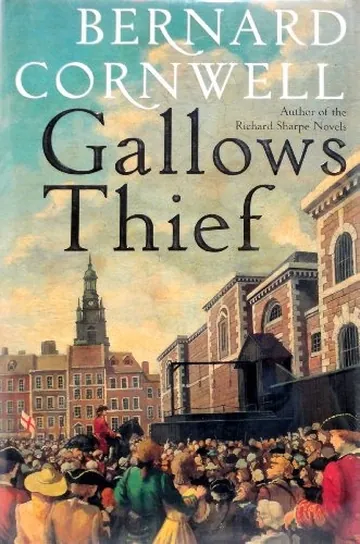
The first page of Gallows Thief
Sir Henry Forrest, banker and alderman of the City of London, almost gagged when he entered the Press Yard, for the smell was terrible, worse than the reek of the sewer outflows where the Fleet Ditch oozed into the Thames. It was a stink from the cesspits of hell, an eye-watering stench that took a man’s breath away and made Sir Henry take an involuntary step backward, clap a handkerchief to his nose, and hold his breath for fear that he was about to vomit.
Sir Henry’s guide chuckled. “I don’t notice the smell no more, sir,” he said, “but I suppose it’s mortal bad in its way, mortal bad. Mind the steps here, sir, do mind ’em.”
Sir Henry gingerly took the handkerchief away and forced himself to speak. “Why is it called the Press Yard?”
“In days gone by, sir, this is where the prisoners was pressed. They was squashed, sir. Weighed down by stones, sir, to persuade them to tell the truth. We don’t do it any longer, sir, more’s the pity, and as a consequence they lies like India rugs, sir, like India rugs.” The guide, one of the prison’s turnkeys, was a fat man with leather breeches, a stained coat, and a stout billy club. He laughed. “There ain’t a guilty man or woman in here, sir, not if you asks them!”
Continue reading
Sir Henry tried to keep his breathing shallow so he would not have to inhale the noxious miasma of ordure, sweat, and rot. “There is sanitation here?” he asked.
“Very up-to-date, Sir Henry, very up-to-date. Proper drains in Newgate, sir. We spoils them, we do, but they’re filthy animals, sir, filthy. They fouls their own nest, sir, that’s what they do, they fouls their own nest.”
The turnkey closed and bolted the barred gate by which they had entered the yard. “The condemned have the freedom of the Press Yard, sir, during daylight,” he said, “except on high days and holidays like today.” He grinned, letting Sir Henry know that this was a jest. “They has to wait till we’re done, sir, and if you turn to your left you can join Mr. Brown and the other gentlemen in the Association Room.”
“The Association Room?” Sir Henry inquired.
“Standard Cornwell, this time with enough effluvial smells to make a bloodhound hold its breath.”
Kirkus Reviews

The first page of Utopia Avenue
Dean hurries past the Phoenix Theatre, dodges a blind man in dark glasses, steps onto Charing Cross Road to overtake a slow-moving woman and pram, leaps a grimy puddle, and swerves into Denmark Street where he skids on a sheet of black ice. His feet fly up. He’s in the air long enough to see the gutter and sky swap places and to think, This’ll bloody hurt, before the pavement slams his ribs, kneecap, and ankle. It bloody hurts. Nobody stops to help him up. Bloody London. A bewhiskered stockbroker type in a bowler hat smirks at the long-haired lout’s misfortune and is gone. Dean gets to his feet, gingerly, ignoring the throbs of pain, praying that nothing’s broken. Mr. Craxi doesn’t do sick pay. His wrists and hands are working, at least. The money. He checks that his bankbook with its precious cargo of ten five-pound notes is safe in his coat pocket.
Continue reading
All’s well. He hobbles along. He recognizes Rick “One Take” Wakeman in the window of the Gioconda café across the street. Dean wishes he could join Rick for a cuppa, a smoke, and a chat about session work, but Friday morning is rent-paying morning, and Mrs. Nevitt is waiting in her parlor like a giant spider. Dean’s cutting it fine this week, even by his standards. Ray’s bank order only arrived yesterday, and the queue to cash it just now took forty minutes, so he pushes on, past Lynch Lupton’s Music Publishers, where Mr. Lynch told Dean all his songs were shit, except the few that were drivel. Past Alf Cummings Music Management, where Alf Cummings put his podgy hand on Dean’s inner thigh and murmured, “We both know what I can do for you, you beautiful bastard; the question is, What will you do for me?” and past Fungus Hut Studios, where Dean was due to record a demo with Battleship Potemkin before the band booted him out.
“HELP, please, I’m—” A red-faced man grabs Dean’s collar and grunts, “I’m—” He doubles over in agony. “It’s killing me...”
“All right mate, sit down on the step here. Where’s it hurt?”
Spit dribbles from the man’s twisted mouth. “Chest...”
“’S okay, we’ll, uh... get yer help.” He looks around, but people rush by with collars up, caps down, and eyes averted.
The man whimpers and leans into Dean. “Aaa-aaaggh.”
“Mate, I think yer need an ambulance, so—”
“What seems to be the problem?” The new arrival is Dean’s age, has short hair and a sensible duffel coat. He loosens the collapsed man’s tie and peers into his eyes. “I say, my name’s Hopkins. I’m a doctor. Nod if you understand me, sir.”
The man grimaces, gasps, and manages to nod, once.
“Good.” Hopkins turns to Dean. “Is the gentleman your father?”
“Nah, I never seen him till now. His chest hurts, he said.”
“Chest, is it?” Hopkins removes a glove and presses his hand against a vein in the man’s neck. “Highly arrhythmic. Sir? I believe you’re having a heart attack.”
The man’s eyes widen; fresh pain scrunches them up.
“The café’s got a phone,” says Dean. “I’ll call nine-nine-nine.”
“It’ll never arrive in time,” says Hopkins. “The traffic’s blue bloody murder on Charing Cross Road, do you happen to know Frith Street?”
“Yeah, I do—and there’s a clinic, up by Soho Square.”
“Exactly. Run there as fast as you can, tell them a chap’s having a heart attack outside the tobacconist on Denmark Street and that Dr. Hopkins needs a stretcher team, pronto. Got all that?”
Hopkins, Denmark Street, stretcher. “Got it.”
“Good man. I’ll stay here to administer first aid. Now run like the bloody clappers. This poor devil’s depending on you.”
“Noted novelist Mitchell returns with a gritty, richly detailed fable from rock’s golden age.”
Kirkus Reviews

The first page of He Died with His Eyes Open
He was found in the shrubbery in front of the Word of God House in Albatross Road, West Five. It was the thirtieth of March, during the evening rush-hour. It was bloody cold; and an office worker had tripped over the body when he was caught short going home. I don’t know if you know Albatross Road where it runs into Hanger Lane, but if you do you’ll appreciate what a ghastly lonely area it is, with the surface-level tube-station on one side of the street, and dank, blind buildings, weeping with damp, on the other. That evening there was yet another go-slow on, and when I arrived at seven there were people still massing to get down the tube stairs to the trains, which were running very rare.
It was pelting with rain on an east wind when I got there. I found Bowman from Serious Crimes standing over the corpse with a torch, talking to the two coppers off the beat who had been called by the man who had stumbled on him. Water ran off the brim of Bowman’s trilby and dribbled down the helmets of the wooden-tops to end up in their collars. Bowman handed me the torch without a word and I bent over the dead man. His eyes were open—one only just—the surfaces peppered with the grit that an east wind hurls at you off London streets. He was wearing a cheap grey suit with cigarette burns down the front and a tatty raincoat. He was medium height, with thin hair turning grey and a boozer’s nose, aged between fifty and sixty. Both his arms were broken, and one leg; the bone poked out blue through the trouser cloth. His head had been battered in below the hairline and brains had slopped down his left cheek into the mud. I got the impression, though, that despite his injuries he hadn’t died at once. In the dull eyes there was still a flicker of some memory that he meant to take with him wherever he was going.
Continue reading
When I had finished I stepped back with a last glance at his face. They had left some of it, I will say, whoever they were. It wasn’t a strong face, but one that had seen everything and then not understood it until it was too late. I’ve seen plenty of violent deaths, but never anything worse than this one. His wounds were multiple, but not random. They weren’t consistent with a hit-and-run or even a casual robbery (who would trouble to rob him, though?). No, he had been systematically beaten by one, or more likely two practitioners who knew exactly how to do it. Specialists, you might almost say. Villains, you might almost say.
‘What do you think?’ said Bowman.
‘I think they weren’t joking.’
‘They?’
‘There must have been more than one. No one man could have done all this. And wherever it was done, it wasn’t here—there’s hardly any blood under the body.’
‘Oh, I’d noticed that,’ said one of the size nines in a tone of exaggerated patience. Like all these clever coppers who wanted to make detective-constable but never did, he had been moving around sussing things out. ‘For my money he was done in a motor, then he was dragged out here—you can see the marks in the ground—then dumped to make him look like a derelict hit-and-run, see?’
‘You’re a murderer,’ said Bowman coldly. ‘You’re one of the special kind, a killer that don’t want to get caught. You beat a bloke to death in a motor—blood all over the fucking place. Next, I’m you. I come round to your place and I say, can I have a look at your motor, please? Routine inquiry, sir. Blood everywhere, you berk.’
‘I hadn’t thought of it like that, sir.’
“A noir-drenched British import about a nameless cop chasing the killer of an unmourned victim.”
Kirkus Reviews
Content note: graphic violence
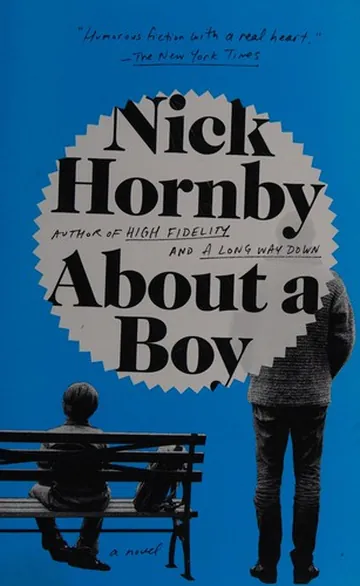
The first page of About a Boy
“No, Marcus, I haven’t got another boyfriend. That’s not how it works. Not when you’re a thirty-eight-year-old working mother. There’s a time problem. Ha! There’s an everything problem. Why? Does it bother you?”
“I dunno.”
And he didn’t know. His mum was sad, he knew that—she cried a lot now, more than she did before they moved to London—but he had no idea whether that was anything to do with boyfriends. He kind of hoped it was, because then it would all get sorted out. She would meet someone, and he would make her happy. Why not? His mum was pretty, he thought, and nice, and funny sometimes, and he reckoned there must be loads of blokes like Roger around. If it wasn’t boyfriends, though, he didn’t know what it could be, apart from something bad.
“Do you mind me having boyfriends?”
“No. Only Andrew.”
“Well, yes, I know you didn’t like Andrew. But generally? You don’t mind the idea of it?”
Continue reading
“No. Course not.”
“You’ve been really good about everything. Considering you’ve had two different sorts of life.”
He understood what she meant. The first sort of life had ended four years ago, when he was eight and his mum and dad had split up; that was the normal, boring kind, with school and holidays and homework and weekend visits to grandparents. The second sort was messier, and there were more people and places in it: his mother’s boyfriends and his dad’s girlfriends; flats and houses; Cambridge and London. You wouldn’t believe that so much could change just because a relationship ended, but he wasn’t bothered. Sometimes he even thought he preferred the second sort of life to the first sort. More happened, and that had to be a good thing.
Apart from Roger, not much had happened in London yet. They’d only been here for a few weeks—they’d moved on the first day of the summer holidays—and so far it had been pretty boring. He had been to see two films with his mum, Home Alone 2, which wasn’t as good as Home Alone 1, and Honey, I Blew Up the Kids, which wasn’t as good as Honey, I Shrunk the Kids, and his mum had said that modern films were too commercial, and that when she was his age . . . something, he couldn’t remember what. And they’d been to have a look at his school, which was big and horrible, and wandered around their new neighbourhood, which was called Holloway, and had nice bits and ugly bits, and they’d had lots of talks about London, and the changes that were happening to them, and how they were all for the best, probably. But really they were sitting around waiting for their London lives to begin.
The pizzas arrived and they ate them straight out of the boxes.
“They’re better than the ones we had in Cambridge, aren’t they?” Marcus said cheerfully. It wasn’t true: it was the same pizza company, but in Cambridge the pizzas hadn’t had to travel so far, so they weren’t quite as soggy. It was just that he thought he ought to say something optimistic. “Shall we watch TV?”
“If you want.”
He found the remote control down the back of the sofa and zapped through the channels.
“…this has the right mix of hilarity and irrepressible characters to attract a wide audience: an upbeat, unqualified success.”
Kirkus Reviews

The first page of The Bone Season
I like to imagine there were more of us in the beginning. Not many, I suppose. But more than there are now.
We are the minority the world does not accept. Not outside of fantasy, and even that’s blacklisted. We look like everyone else. Sometimes we act like everyone else. In many ways, we are like everyone else. We are everywhere, on every street. We live in a way you might consider normal, provided you don’t look too hard.
Not all of us know what we are. Some of us die without ever knowing. Some of us know, and we never get caught. But we’re out there.
Trust me.
I had lived in that part of London that used to be called Islington since I was eight. I attended a private school for girls, leaving at sixteen to work. That was in the year 2056. AS 127, if you use the Scion calendar. It was expected of young men and women to scratch out a living wherever they could, which was usually behind a counter of one sort or another. There were plenty of jobs in the service industry. My father thought I would lead a simple life; that I was bright but unambitious, complacent with whatever work life threw at me.
Continue reading
My father, as usual, was wrong.
From the age of sixteen I had worked in the criminal underworld of Scion London—SciLo, as we called it on the streets. I worked among ruthless gangs of voyants, all willing to floor each other to survive. All part of a citadel-wide syndicate headed by the Underlord. Pushed to the edge of society, we were forced into crime to prosper. And so we became more hated. We made the stories true.
I had my little place in the chaos. I was a mollisher, the protégée of a mime-lord. My boss was a man named Jaxon Hall, the mime-lord responsible for the I-4 area. There were six of us in his direct employ. We called ourselves the Seven Seals.
I couldn’t tell my father. He thought I was an assistant at an oxygen bar, a badly paid but legal occupation. It was an easy lie. He wouldn’t have understood if I’d told him why I spent my time with criminals. He didn’t know that I belonged with them. More than I belonged with him.
I was nineteen years old the day my life changed. Mine was a familiar name on the streets by that time. After a tough week at the black market, I’d planned to spend the weekend with my father. Jax didn’t twig why I needed time off—for him, there was nothing and no one outside the syndicate—but he didn’t have a family like I did. Not a living family, anyway. And although my father and I had never been close, I still felt I should keep in touch. A dinner here, a phone call there, a present at Novembertide. The only hitch was his endless list of questions. What job did I have? Who were my friends? Where was I living?
I couldn’t answer. The truth was dangerous. He might have sent me to Tower Hill himself if he’d known what I really did. Maybe I should have told him the truth. Maybe it would have killed him.
“The internal mythology is complex and intriguing, the emotional struggle is captivating, and the pace rarely falters…”
Publishers Weekly
Questions
Quick answers
Which of these is fantasy?
Two. A Darker Shade of Magic moves between parallel Londons, and The Bone Season is set in a London of 2059 where clairvoyance is a crime.