Books set in Ireland, from a coal merchant’s winter to a Troubles-era city
These novels set in Ireland differ in era and voice, and each one is rooted in its place.

The first page of Small Things Like These
In October there were yellow trees. Then the clocks went back the hour and the long November winds came in and blew, and stripped the trees bare. In the town of New Ross, chimneys threw out smoke which fell away and drifted off in hairy, drawn-out strings before dispersing along the quays, and soon the River Barrow, dark as stout, swelled up with rain.
The people, for the most part, unhappily endured the weather: shop-keepers and tradesmen, men and women in the post office and the dole queue, the mart, the coffee shop and supermarket, the bingo hall, the pubs and the chipper all commented, in their own ways, on the cold and what rain had fallen, asking what was in it – and could there be something in it – for who could believe that there, again, was another raw-cold day? Children pulled their hoods up before facing out to school, while their mothers, so used now to ducking their heads and running to the clothesline, or hardly daring to hang anything out at all, had little faith in getting so much as a shirt dry before evening. And then the nights came on and the frosts took hold again, and blades of cold slid under doors and cut the knees off those who still knelt to say the rosary.
Continue reading
Down in the yard, Bill Furlong, the coal and timber merchant, rubbed his hands, saying if things carried on as they were, they would soon need a new set of tyres for the lorry.
‘She’s on the road every hour of the day,’ he told his men. ‘We could soon be on the rims.’
And it was true: hardly had one customer left the yard before another arrived in, fresh on their heels, or the phone rang – with almost everyone saying they wanted delivery now or soon, that next week wouldn’t do.
Furlong sold coal, turf, anthracite, slack and logs. These were ordered by the hundredweight, the half hundredweight or the full tonne or lorry load. He also sold bales of briquettes, kindling and bottled gas. The coal was the dirtiest work and had, in winter, to be collected monthly, off the quays. Two full days it took for the men to collect, carry, sort and weigh it all out, back at the yard. Meanwhile, the Polish and Russian boatmen were a novelty going about town in their fur caps and long, buttoned coats, with hardly a word of English.
During busy times like these, Furlong made most of the deliveries himself, leaving the yardmen to bag up the next orders and cut and split the loads of felled trees the farmers brought in. Through the mornings, the saws and shovels could be heard going hard at it, but when the Angelus bell rang, at noon, the men laid down their tools, washed the black off their hands, and went round to Kehoe’s, where they were fed hot dinners with soup, and fish & chips on Fridays.
‘The empty sack cannot stand,’ Mrs Kehoe liked to say, standing behind her new buffet counter, slicing up the meat and dishing out the veg and mash with her long, metal spoons.
Gladly, the men sat down to thaw out and eat their fill before having a smoke and facing back out into the cold again.
“A stunning feat of storytelling and moral clarity.”
Kirkus Reviews
Content note: abuse of girls and women in a convent laundry

The first page of Brooklyn
Eilis Lacey, sitting at the window of the upstairs living room in the house on Friary Street, noticed her sister walking briskly from work. She watched Rose crossing the street from sunlight into shade, carrying the new leather handbag that she had bought in Clerys in Dublin in the sale. Rose was wearing a cream-coloured cardigan over her shoulders. Her golf clubs were in the hall; in a few minutes, Eilis knew, someone would call for her and her sister would not return until the summer evening had faded.
Eilis's bookkeeping classes were almost ended now; she had a manual on her lap about systems of accounting, and on the table behind her was a ledger where she had entered, as her homework, on the debit and credit sides, the daily business of a company whose details she had taken down in notes in the Vocational School the week before.
Continue reading
As soon as she heard the front door open, Eilis went downstairs. Rose, in the hall, was holding her pocket mirror in front of her face. She was studying herself closely as she applied lipstick and eye make-up before glancing at her overall appearance in the large hall mirror, settling her hair. Eilis looked on silently as her sister moistened her lips and then checked herself one more time in the pocket mirror before putting it away.
Their mother came from the kitchen to the hall.
“You look lovely, Rose,” she said. “You’ll be the belle of the golf club.”
“I’m starving,” Rose said, “but I’ve no time to eat.”
“I’ll make a special tea for you later,” her mother said. “Eilis and myself are going to have our tea now.”
Rose reached into her handbag and took out her purse. She placed a one-shilling piece on the hallstand. “That’s in case you want to go to the pictures,” she said to Eilis.
“And what about me?” her mother asked.
“She’ll tell you the story when she gets home,” Rose replied.
“That’s a nice thing to say!” her mother said.
All three laughed as they heard a car stop outside the door and beep its horn. Rose picked up her golf clubs and was gone.
Later, as her mother washed the dishes and Eilis dried them, another knock came to the door. When Eilis answered it, she found a girl whom she recognized from Kelly’s grocery shop beside the cathedral.
“Miss Kelly sent me with a message for you,” the girl said. “She wants to see you.”
“Does she?” Eilis asked. “And did she say what it was about?”
“No. You’re just to call up there tonight.”
“But why does she want to see me?”
“God, I don’t know, miss. I didn’t ask her. Do you want me to go back and ask her?”
“No, it’s all right. But are you sure the message is for me?”
“I am, miss. She says you are to call in on her.”
Since she had decided in any case to go to the pictures some other evening, and being tired of her ledger, Eilis changed her dress and put on a cardigan and left the house. She walked along Friary Street and Rafter Street into the Market Square and then up the hill to the cathedral. Miss Kelly’s shop was closed, so Eilis knocked on the side door, which led to the upstairs part where she knew Miss Kelly lived. The door was answered by the young girl who had come to the house earlier, who told her to wait in the hall.
“…the possibility of Eilis reclaiming an authentic and spirited life in Ireland turns Brooklyn into a stirring and satisfying moral tale.”
Publishers Weekly

The first page of The Heart’s Invisible Furies
Long before we discovered that he had fathered two children by two different women, one in Drimoleague and one in Clonakilty, Father James Monroe stood on the altar of the Church of Our Lady, Star of the Sea, in the parish of Goleen, West Cork, and denounced my mother as a whore. The family was seated together in the second pew, my grandfather on the aisle using his handkerchief to polish the bronze plaque engraved to the memory of his parents that was nailed to the back of the woodwork before him. He wore his Sunday suit, pressed the night before by my grandmother, who twisted her jasper rosary beads around her crooked fingers and moved her lips silently until he placed his hand atop hers and ordered her to be still. My six uncles, their dark hair glistening with rose-scented lacquer, sat next to her in ascending order of age and stupidity. Each was an inch shorter than the next and the disparity showed from behind. The boys did their best to stay awake that morning; there had been a dance the night before in Skull and they'd come home moldy with the drink, sleeping only a few hours before being roused by their father for Mass.
Continue reading
At the end of the row, beneath a wooden carving of the tenth station of the cross, sat my mother, her stomach fluttering in terror at what was to come. She hardly dared to look up.
The Mass began in the typical fashion, she told me, with the priest's wearied discharge of the Introductory Rites and the congregation's discordant singing of the Kyrie. William Finney, a neighbor of my mother's from Ballydevlin, made his way in all his pomposity to the pulpit for the first and second liturgical readings, clearing his throat into the heart of the microphone before pronouncing every word with such dramatic intensity that he might have been performing on the stage of the Abbey Theater. Father Monroe, perspiring noticeably under the weight of his vestments and the intensity of his anger, followed with the Acclamation and the Gospel before inviting everyone to be seated, and three red-cheeked altar boys scurried to their side-bench, exchanging excited glances. Perhaps they had read the priest's notes in the sacristy beforehand or overheard him rehearse his words as he pulled the cassock down over his head. Or maybe they just knew how much cruelty the man was capable of and were happy that on this occasion it was not being directed toward them.
“My family are all Goleen as far back as records go,” he began, looking out at one hundred and fifty raised heads and a single bowed one. “I heard a terrible rumor once that my great-grandfather had family in Bantry but I never saw any evidence to justify it.” An appreciative laugh from the congregation; a bit of local bigotry never hurt anyone. “My mother,” he continued, “a good woman, loved this parish. She went to her grave having never left a few square miles of West Cork and didn't regret it for a moment. Good people live here, she always told me. Good, honest, Catholic people. And do you know something, I never had cause to doubt her. Until today.”
There was a ripple around the church.
“Until today,” repeated Father Monroe slowly, shaking his head in sorrow. “Is Catherine Goggin in attendance this morning?” He looked around as if he had no idea where he might find her, even though she had been seated in the same pew every Sunday morning for the past sixteen years. In a moment, the head of every man, woman and child present turned in her direction. Every head, that is, except for those of my grandfather and six uncles, who stared resolutely forward, and my grandmother, who lowered hers now just as my mother raised her own in a see-saw of shame.
“Catherine Goggin, there you are,” said the priest, smiling at her and beckoning her forward. “Come on up here to me now like a good girl.”
“A dark novel marred by occasional melodrama but lightened by often hilarious dialogue.”
Kirkus Reviews
Content note: homophobic violence, child and sexual abuse
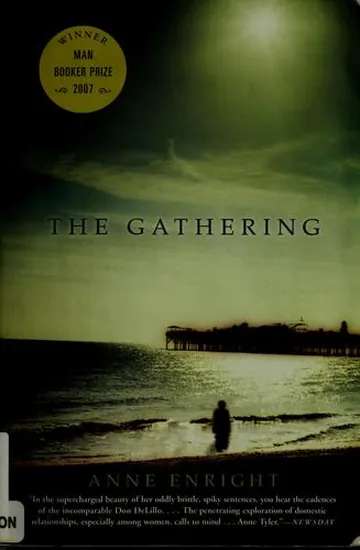
The first page of The Gathering
I would like to write down what happened in my grandmother's house the summer I was eight or nine, but I am not sure if it really did happen. I need to bear witness to an uncertain event. I feel it roaring inside me - this thing that may not have taken place. I don't even know what name to put on it. I think you might call it a crime of the flesh, but the flesh is long fallen away and I am not sure what hurt may linger in the bones. My brother Liam loved birds and, like all boys, he loved the bones of dead animals. I have no sons myself, so when I pass any small skull or skeleton I hesitate and think of him, how he admired their intricacies. A magpie's ancient arms coming through the mess of feathers; stubby and light and clean. That is the word we use about bones: Clean.
Continue reading
I tell my daughters to step back, obviously, from the mouse skull in the woodland or the dead finch that is weathering by the garden wall. I am not sure why. Though sometimes we find, on the beach, a cuttlefish bone so pure that I have to slip it in my pocket, and I comfort my hand with the secret white arc of it.
You can not libel the dead, I think, you can only console them.
So I offer Liam this picture: my two daughters running on the sandy rim of a stony beach, under a slow, turbulent sky, the shoulders of their coats shrugging behind them. Then I erase it. I close my eyes and roll with the sea’s loud static. When I open them again, it is to call the girls back to the car.
Rebecca! Emily! It does not matter. I do not know the truth, or I do not know how to tell the truth. All I have are stories, night thoughts, the sudden convictions that uncertainty spawns. All I have are ravings, more like. She loved him! I say. She must have loved him! I wait for the kind of sense that dawn makes, when you have not slept. I stay downstairs while the family breathes above me and I write it down, I lay them out in nice sentences, all my clean, white bones.
SOME DAYS I don’t remember my mother. I look at her photograph and she escapes me. Or I see her on a Sunday, after lunch, and we spend a pleasant afternoon, and when I leave I find she has run through me like water. ‘Goodbye,’ she says, already fading. ‘Goodbye my darling girl,’ and she reaches her soft old face up, for a kiss. It still puts me in such a rage. The way, when I turn away, she seems to disappear, and when I look, I see only the edges. I think I would pass her in the street, if she ever bought a different coat. If my mother committed a crime there would be no witnesses - she is forgetfulness itself.
‘Where’s my purse?’ she used to say when we were children - or it might be her keys, or her glasses. ‘Did anyone see my purse?” becoming, for those few seconds, nearly there, as she went from hall, to sitting room, to kitchen and back again. Even then we did not look at her but everywhere else: she was an agitation behind us, a kind of collective guilt, as we cast about the room, knowing that our eyes would slip over the purse, which was brown and fat, even if it was quite clearly there.
“A melancholic love and rage bubbles just beneath the surface of this Dublin clan, and Enright explores it unflinchingly.”
Publishers Weekly
Content note: child sexual abuse, suicide

The first page of The Witch Elm
I've always considered myself to be, basically, a lucky person. I don't mean I'm one of those people who pick multi-million-euro lotto numbers on a whim, or show up seconds too late for flights that go on to crash with no survivors. I just mean that I managed to go through life without any of the standard misfortunes you hear about. I wasn't abused as a kid, or bullied in school; my parents didn't split up or die or have addiction problems or even get into any but the most trivial arguments; none of my girlfriends ever cheated on me, at least as far as I know, or dumped me in traumatic ways; I never got hit by a car or caught anything worse than chicken pox or even had to wear braces. Not that I spent much time thinking about this, but when it occurred to me, it was with a satisfying sense that everything was going exactly as it should.
Continue reading
And of course there was the Ivy House. I don’t think anyone could convince me, even now, that I was anything other than lucky to have the Ivy House. I know it wasn’t that simple, I know all the reasons in intimate, serrated detail; I can lay them out in a neat line, stark and runic as black twigs on snow, and stare at them till I almost convince myself; but all it takes is one whiff of the right smell—jasmine, lapsang souchong, a specific old-fashioned soap that I’ve never been able to identify—or one sideways shaft of afternoon light at a particular angle, and I’m lost, in thrall all over again.
Not long ago I actually rang my cousins about it—it was almost Christmas, I was a little drunk on mulled wine from some godawful work party, or I would never have rung them, or at any rate not to ask their opinions, or their advice, or whatever it is I thought I was looking for. Susanna clearly felt it was a silly question—“Well, yeah, obviously we were lucky. It was an amazing place.” And into my silence: “If you’re getting hung up on all the other stuff, then personally”—long deft slice of scissors through paper, choirboys sweet and buoyant in the background, she was wrapping presents—“I wouldn’t. I know that’s easier said, but seriously, Toby, picking at it after how many years, what’s the point? But you do you.” Leon, who at first had sounded genuinely pleased to hear from me, tightened up instantly: “How am I supposed to know? Oh, listen, while I have you, I meant to email you, I’m thinking of coming home for a bit at Easter, are you going to be”—I got mildly belligerent and demanded an answer, which I knew perfectly well has always been the wrong way to deal with Leon, and he pretended his reception had gone and hung up on me.
And yet; and yet. It matters; matters, as far as I can see—for whatever that’s worth, at this point—more than anything. It’s taken me this long to start thinking about what luck can be, how smoothly and deliciously deceptive, how relentlessly twisted and knotted in on its own hidden places, and how lethal.
“The pace is slow, but the story is compelling, and French is deft in unraveling this book’s puzzles.”
Kirkus Reviews
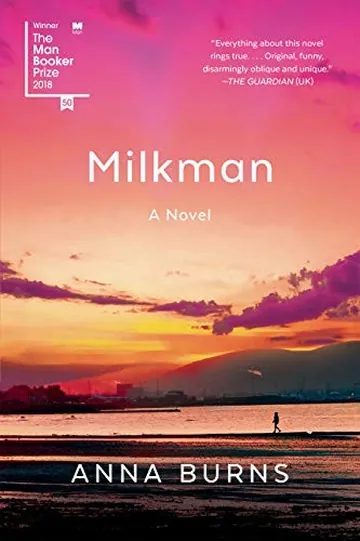
The first page of Milkman
The day Somebody McSomebody put a gun to my breast and called me a cat and threatened to shoot me was the same day the milkman died. He had been shot by one of the state hit squads and I did not care about the shooting of this man. Others did care though, and some were those who, in the parlance, 'knew me to see but not to speak to' and I was being talked about because there was a rumour started by them, or more likely by first brother-in-law, that I had been having an affair with this milkman and that I was eighteen and he was forty-one. I knew his age, not because he got shot and it was given by the media, but because there had been talk before this, for months before the shooting, by these people of the rumour, that forty-one and eighteen was disgusting, that twenty-three years’ difference was disgusting, that he was married and not to be fooled by me for there were plenty of quiet, unnoticeable people who took a bit of watching.
Continue reading
It had been my fault too, it seemed, this affair with the milkman. But I had not been having an affair with the milkman. I did not like the milkman and had been frightened and confused by his pursuing and attempting an affair with me. I did not like first brother-in-law either. In his compulsions he made things up about other people’s sexlives. About my sexlife. When I was younger, when I was twelve, when he appeared on my eldest sister’s rebound after her long-term boyfriend got dumped for cheating on her, this new man got her pregnant and they got married right away. He made lewd remarks about me to me from the first moment he met me – about my quainte, my tail, my contry, my box, my jar, my contrariness, my monosyllable – and he used words, words sexual, I did not understand. He knew I didn’t understand them but that I knew enough to grasp they were sexual. That was what gave him pleasure. He was thirty-five. Twelve and thirty-five. That was a twenty-three years’ difference too.
So he made his remarks and felt entitled to make his remarks and I did not speak because I did not know how to respond to this person. He never made his comments when my sister was in the room. Always, whenever she’d leave the room, it was a switch turned on inside him. On the plus side, I wasn’t physically frightened of him. In those days, in that place, violence was everybody’s main gauge for judging those around them and I could see at once he didn’t have it, that he didn’t come from that perspective. All the same, his predatory nature pushed me into frozenness every time. So he was a piece of dirt and she was in a bad way with being pregnant, with still loving her long-term man and not believing what he’d done to her, disbelieving he wasn’t missing her, for he wasn’t. He was off now with somebody else. She didn’t really see this man here, this older man she’d married but had been too young herself, and too unhappy, and too in love – just not with him – to have taken up with him. I stopped visiting even though she was sad because I could no longer take his words and facial expressions. Six years on, as he tried to work his way through me and my remaining elder sisters, with the three of us – directly, indirectly, politely, fuck off-ly – rejecting him, the milkman, also uninvited but much more frightening, much more dangerous, stepped from out of nowhere onto the scene.
I didn’t know whose milkman he was. He wasn’t our milkman. I don’t think he was anybody’s. He didn’t take milk orders. There was no milk about him. He didn’t ever deliver milk. Also, he didn’t drive a milk lorry.
“A deeply stirring, unforgettable novel that feels like a once-in-a-generation event.”
Kirkus Reviews
Questions
Quick answers
What is a good novel to start with for Irish fiction?
For a short, quiet read, Small Things Like These. For a big, readable saga, The Heart’s Invisible Furies. For a Dublin thriller, The Witch Elm.
Are all of these set in the Republic of Ireland?
No. Milkman is set in an unnamed city in Northern Ireland, and Brooklyn opens in Ireland and then moves to New York.
Which of these are Booker Prize winners?
The Gathering (2007) and Milkman (2018).