Books like Daisy Jones & The Six, about fame, bands and messy love
Daisy Jones & The Six is told like a rock documentary, starting with a girl growing up in the Hollywood Hills. These keep that pull of fame, music and people who cannot quite leave each other alone.

The first page of Daisy Jones & The Six
Daisy Jones was born in 1951 and grew up in the Hollywood Hills of Los Angeles, California. The daughter of Frank Jones, the well-known British painter, and Jeanne LeFevre, a French model, Daisy started to make a name for herself in the late sixties as a young teenager on the Sunset Strip.
ELAINE CHANG (biographer, author of Daisy Jones: Wild Flower): Here is what is so captivating about Daisy Jones even before she was “Daisy Jones.”
You’ve got a rich white girl, growing up in L.A. She’s gorgeous—even as a child. She has these stunning big blue eyes—dark, cobalt blue. One of my favorite anecdotes about her is that in the eighties a colored-contact company actually created a shade called Daisy Blue.
She’s got copper-red hair that is thick and wavy and... takes up so much space. And then her cheekbones almost seem swollen, that’s how defined they are. And she’s got an incredible voice that she doesn’t cultivate, never takes a lesson. She’s born with all the money in the world, access to whatever she wants—artists, drugs, clubs—anything and everything at her disposal.
Continue reading
But she has no one. No siblings, no extended family in Los Angeles. Two parents who are so into their own world that they are all but indifferent to her existence. Although, they never shy away from making her pose for their artist friends. That’s why there are so many paintings and photos of Daisy as a child—the artists that came into that home saw Daisy Jones, saw how gorgeous she was, and wanted to capture her. It’s telling that there is no Frank Jones piece of Daisy. Her father is too busy with his male nudes to pay much attention to his daughter. And in general, Daisy spends her childhood rather alone.
But she’s actually a very gregarious, outgoing kid—Daisy would often ask to get her hair cut just because she loved her hairdresser, she would ask neighbors if she could walk their dogs, there was even a family joke about the time Daisy tried to bake a birthday cake for the mailman. So this is a girl that desperately wants to connect. But there’s no one in her life who is truly interested in who she is, especially not her parents. And it really breaks her. But it is also how she grows up to become an icon.
We love broken, beautiful people. And it doesn’t get much more obviously broken and more classically beautiful than Daisy Jones.
So it makes sense that Daisy starts to find herself on the Sunset Strip. This glamorous, seedy place.
I could walk down to the Strip from my house. I was about fourteen, sick of being stuck in the house, just looking for something to do. I wasn’t old enough to get into any of the bars and clubs but I went anyway.
I remember bumming a cigarette off of a roadie for the Byrds when I was pretty young. I learned quickly that people thought you were older if you didn’t wear your bra. And sometimes I’d wear a bandanna headband like the cool girls had on. I wanted to fit in with the groupies on the sidewalk, with their joints and their flasks and all of that.
So I bummed a cigarette from this roadie outside the Whisky a Go Go one night—the first time I’d ever had one and I tried to pretend I did it all the time. I held the cough in my throat and what have you—and I was flirting with him the best I could. I’m embarrassed to think about it now, how clumsy I probably was.
But eventually, some guy comes up to the roadie and says, “We gotta get inside and set up the amps.” And he turns to me and says, “You coming?” And that’s how I snuck into the Whisky for the first time.
I stayed out that night until three or four in the morning. I’d never done anything like that before. But suddenly it was like I existed. I was a part of something. I went from zero to sixty that night. I was drinking and smoking anything anybody would give me.
When I got home, I walked in through the front door, drunk and stoned, and crashed in my bed. I’m pretty sure my parents never even noticed I was gone.
I got up, went out the next night, did the same thing.
Eventually, the bouncers on the Strip recognized me and let me in wherever I was going. The Whisky, London Fog, the Riot House. No one cared how young I was.
“…a stunning story of sex, drugs, and rock ’n’ roll in the 1960s and ’70s…”
Publishers Weekly

The first page of Malibu Rising
Malibu catches fire.
It is simply what Malibu does from time to time.
Tornadoes take the flatlands of the Midwest. Floods rise in the American South. Hurricanes rage against the Gulf of Mexico.
And California burns.
The land caught fire time and again when it was inhabited by the Chumash in 500 B.C.E. It caught fire in the 1800s when Spanish colonizers claimed the area. It caught fire on December 4, 1903, when Frederick and May Rindge owned the stretch of land now called Malibu. The flames seized thirty miles of coastland and consumed their Victorian beach house.
Malibu caught fire in 1917 and 1929, well after the first movie stars got there. It caught fire in 1956 and 1958, when the longboarders and beach bunnies trickled to its shores. It caught fire in 1970 and 1978, after the hippies settled in its canyons.
It caught fire in 1982, 1985, in 1993, 1996, in 2003, 2007, and 2018. And times in between.
Continue reading
Because it is Malibu's nature to burn.
At the city line of Malibu today stands a sign that reads, MALIBU, 27 MILES OF SCENIC BEAUTY. The long, thin township—an area that hugs the slim coast for almost thirty miles—is made up of ocean and mountain, split by a two-lane throughway called the Pacific Coast Highway, or PCH.
To the west of PCH is a long series of beaches cradling the crystal blue waves of the Pacific Ocean. In many areas along the coast, beach houses are crammed along the side of the highway, competing for views, narrow and tall. The coastline is jagged and rocky. The waves are brisk and clear. The air smells of fresh brine.
Directly to the east of PCH lie the immense, arid mountains. They dominate the skyline, sage green and umber, composed of desert shrubs and wild trees, brittle underbrush.
This is dry land. A tinderbox. Blessed and cursed with a breeze.
The local Santa Ana winds speed through the mountains and valleys from the inland to the shore, hot and strong. Myth says they are agents of chaos and disorder. But what they really are is an accelerant.
A tiny spark in the dry desert wood can grow to a blaze and run wild, burning bright orange and red. It devours the land and exhales thick black smoke that overtakes the sky, dimming the sun for miles, ash falling like snow.
Habitats—brush and shrubs and trees—and homes—cabins and mansions and bungalows, ranches and vineyards and farms—go up in smoke and leave behind a scorched earth.
But that land is young once again, ready to grow something new.
Destruction. And renewal, rising from the ashes. The story of fire.
The Malibu fire of 1983 started not in the dry hills but on the coastline.
It began at 28150 Cliffside Drive on Saturday, August 27—at the home of Nina Riva—during one of the most notorious parties in Los Angeles history.
The annual party grew wildly out of control sometime around midnight.
By 7:00 A.M., the coastline of Malibu was engulfed in flames.
Because, just as it is in Malibu's nature to burn, so was it in one particular person's nature to set fire and walk away.
“A compulsively readable story about the bonds between family members and the power of breaking free.”
Kirkus Reviews

The first page of Maybe in Another Life
It’s a good thing I booked an aisle seat, because I’m the last one on the plane. I knew I’d be late for my flight. I’m late for almost everything. That’s why I booked an aisle seat in the first place. I hate making people get up so that I can squeeze by. This is also why I never go to the bathroom during movies, even though I always have to go to the bathroom during movies.
I walk down the tight aisle, holding my carry-on close to my body, trying not to bump anyone. I hit a man’s elbow and apologize even though he doesn’t seem to notice. When I barely graze a woman’s arm, she shoots daggers at me as if I stabbed her. I open my mouth to say I’m sorry and then think better of it.
I spot my seat easily; it is the only open one. The air is stale. The music is Muzak. The conversations around me are punctuated by the clicks of the overhead compartments being slammed shut. I get to my seat and sit down, smiling at the woman next to me. She’s older and round, with short salt-and-pepper hair. I shove my bag in front of me and buckle my seat belt. My tray table’s up. My electronics are off. My seat is in the upright position. When you’re late a lot, you learn how to make up for lost time. I look out the window. The baggage handlers are bundled up in extra layers and neon jackets. I’m happy to be headed to a warmer climate. I pick up the in-flight magazine.
Continue reading
Soon I hear the roar of the engine and feel the wheels beneath us start to roll. The woman next to me grips the armrests as we ascend. She looks petrified.
I’m not scared of flying. I’m scared of sharks, hurricanes, and false imprisonment. I’m scared that I will never do anything of value with my life. But I’m not scared of flying.
Her knuckles are white with tension. I tuck the magazine back into the pouch. “Not much of a flier?” I ask her. When I’m anxious, talking helps. If talking helps her, it’s the least I can do.
The woman turns and looks at me as we glide into the air. “Fraid not,” she says, smiling ruefully. “I don’t leave New York very often. This is my first time flying to Los Angeles.”
“Well, if it makes you feel any better, I fly a fair amount, and I can tell you, with any flight, it’s really only takeoff and landing that are hard. We’ve got about three more minutes of this part and then about five minutes at the end that can be tough. The rest of it . . . you might as well be on a bus. So just eight bad minutes total, and then you’re in California.”
We’re at an incline. It’s steep enough that an errant bottle of water rolls down the aisle.
“Eight minutes is all?” she asks. I nod. “That’s it,” I tell her. “You’re from New York?”
She nods. “How about you?”
I shrug. “I was living in New York. Now I’m moving back to L.A.”
The plane drops abruptly and then rights itself as we make our way past the clouds. She breathes in deeply. I have to admit, even I feel a little queasy.
“Entertaining and unpredictable; Reid makes a compelling argument for happiness in every life.”
Kirkus Reviews
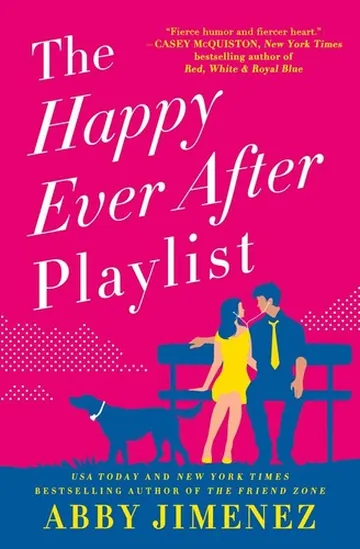
The first page of The Happy Ever After Playlist
“Do you want me to meet you at the cemetery, Sloan?”
Kristen was worried about me.
I shook my head at my car’s center console, where my phone sat on speaker. “I’m fine. I’m going to the farmers’ market afterward,” I said, hoping that would placate her.
My car idled at the red light next to a sidewalk lined with worn-out businesses and thirsty, drought-resistant oaks that looked like the lack of rain had finally broken their spirit. I baked in the blazing sun. My open sunroof had broken over Easter weekend a few weeks ago and I’d never fixed it, part of my time-honored tradition of not repairing things in my crappy car.
“The farmers’ market? Are you going to cook?” Kristen’s voice lit up with hope.
“No. A salad maybe,” I said as the light turned green. I didn’t cook anymore. Everyone knew that. I didn’t do a lot of things anymore. “Oh. Well, do you want me to come over later?” she asked. “I’ll bring cookie dough and liquor.”
Continue reading
“No. I’ll be—Oh my God!” A furry, copper-colored blur darted into the road, and I slammed on the brakes. My phone became a projectile into the dash and my purse dumped over the passenger seat, spilling tampons and single-serve flavored creamers.
“Sloan! What happened?”
I clutched the wheel, my heart pounding. “Kristen, I gotta go. I…I think I just killed a dog.” I hit the End Call button and unclenched myself, threw the car in park, and put a trembling hand on the door to wait for a break in traffic to get out.
Please let it have been quick and painless. Please.
This would destroy me. This was just what it would take. The limp body of somebody’s poor pet under the tires of my shitty car on this particular cursed day, and what little joy I had left would just pop out and float off.
*I hate my life.
My throat tightened. I promised myself I wouldn’t cry today. I promised…
*Barking.
A floppy-eared dog head popped up over my bumper, sniffing the air. I barely had time to process that this animal was still alive before it leapt up onto the hood. He yapped at me through the glass and then grabbed my windshield wiper and started tugging on it.
“What the…” I tilted my head, actually laughing a little. The muscles involved felt weak from disuse, and for a heartbeat, just a flicker of a moment, I forgot what today was.
I forgot I was on my way to visit a grave.
My cell phone pinged with a quick succession of texts. Probably Kristen, losing her shit.
This was why I never got up this early. Nothing but mayhem. Was this what went on in Canoga Park at 9:00 a.m. on a Friday? Dogs running all willy-nilly in the streets?
A horn blared and a middle finger shot up from a passing convertible. My car sat parked in the road with a dog on the hood.
I leapt into action to stage a mid-street rescue. I didn’t want him to bolt and get hit in the road. I waited again for a pause in the cars while the dog crouched on his haunches and barked at me through the glass. I was shaking my head at him when he backed up, gave me one more smiling head cock, scaled my windshield, and dove through my sunroof.
He landed on top of me in a wallop of flying fur and legs. The air was pushed from my lungs in an *oomph as a foot slid right down my tank top into my cleavage, sticking the landing and scratching me from collarbone to belly button. Then he was on me, paws on my shoulders, licking my face and whining like we’d grown up together and I’d just gotten home from college.
I screamed like I was being eaten alive.
I wrestled him off me into the passenger seat, gasping and disheveled, dog drool on my face, and when my cell phone rang I grabbed for it reflexively.
“Sloan, are you okay?” Kristen asked before I even got the phone to my ear.
“A dog just jumped through my sunroof!”
“What?”
“Yeah.” I wiped my cheek with the bottom of my tank top. “It’s…it’s in my front seat.”
The dog smiled at me. He actually grinned as his tail whacked back and forth. Then he lowered his head and made a single cackling noise. I watched in horror as he hacked up a slimy ball of grass right into my drink holder over my untouched latte.
“A perfect blend of smart, heart-wrenching, and fun.”
Kirkus Reviews
Questions
Quick answers
Is Daisy Jones based on a real band?
It reads like one. Reid has said Fleetwood Mac was an inspiration, but the band and the interviews are invented.