Books set in Paris, from an 1840 riverboat to an apartment full of secrets
A steamboat leaving the Quai Saint-Bernard in 1840, a jeweler’s shop in the Palais Royal during the Great War, a mesmerist in 1938, the American Library under occupation, a department store turned labor camp and a building where every tenant hides something. Read the first page of each.

The first page of Sentimental Education
ON 15 September 1840, at around six o’clock in the morning, La Ville-de-Montereau, almost ready to leave, was puffing out thick clouds of smoke alongside the Quai Saint-Bernard. Passengers were arriving, out of breath; barrels, ropes, baskets of washing got in their way; the sailors made answer to no one; people bumped into one another; packages were piling up between the paddle boxes; and the din on the quay was absorbed in the hissing of the steam escaping through the metal plates, enveloping everything in a whitish mist, while the bell in the ship’s bows sounded its insistent clanging. At last the ship left, and the two riverbanks, lined with shops, workers’ yards, and factories, slipped away like two wide ribbons being unspooled. A young man of eighteen with long hair, holding a notebook under his arm, stood near the helm, not moving. He gazed through the mist at the church towers, at the buildings he could not put a name to; then in one last glance he embraced the Ile Saint-Louis, the Cité, Notre-Dame; and before long, as Paris disappeared, he heaved a deep sigh.
Continue reading
Monsieur Frédéric Moreau, having just passed his baccalaureate, was going back to Nogent-sur-Seine to idle away two months before going to read for the Bar. His mother had sent him, with the necessary sum of money, to Le Havre to visit an uncle who, she hoped, would leave him something in his will; he had returned only the night before; and he was making up for not being able to stay in the capital by taking the longest route back to his home in the provinces. The noise subsided; they had all found seats; but some remained standing close to the engine, warming themselves, and the funnel spat out, with a slow, rhythmic rattle, its plume of black smoke; tiny drops of dew trickled down the brass; the deck shuddered with a dull internal vibration and the two paddle wheels, turning at speed, churned up the water. The riverbank had little sandy shores on either side.
Sometimes they came across timber rafts and set them rocking with their wash; in his rowing boat a man sat fishing; then the drifts of fog melted, the sun appeared, and the hill, which followed the course of the Seine on the right, gradually fell away, while another, closer, rose up on the opposite bank. On it was a crown of trees, amongst low houses with Italianate roofs. They had sloping gardens separated by newly built walls, wrought-iron fences, lawns, hothouses, and large pots of geraniums spaced at regular intervals on terraces you could lean over. Many a man, at the sight of those peaceful, stylish residences, felt the desire to be the owner of one, to see out his days there with a nice billiard room, a rowing boat, a wife—or some other pipe dream. The rather novel pleasure of a boat trip encouraged passengers to exchange confidences. The more droll amongst them were already beginning to laugh and tell jokes. Many sang songs. They were jolly together. They offered one another a drop to drink. Frédéric thought of his room at home, the kind of play he might write, the pictures he might paint, and of future passions. The happiness his noble soul deserved seemed a long time coming. He recited melancholy verses to himself; he paced rapidly up and down the deck; he went to the far end by the ship’s bell, and saw a man, in a group of passengers and sailors, flirting with a country girl, while fondling the gold crucifix she was wearing on her breast. He was a curly-haired fellow of some forty years.

The first page of The Secret Language of Stones
Every morning the pavement in front of our shop in the Palais Royal is washed clean by the tears of the mothers of dead soldiers, widowed wives, and heartsick lovers. Look to the right and left. There is grit and grime in front of Giselles Glove Emporium and the family Thibaut’s umbrella store, but at La Fantaisie Russe, the walkway is sparkling like newly polished stones. Here inside the mythic Palais Royal arcade, the stores are not as busy as they were before the war, except for ours. In fact, it’s the war that’s responsible for our steady stream of clients. There is nothing to identify what we offer in advertisements. Visitez le Palais Royal, invites the dark-haired seductress in the prewar poster painted by a friend of my mother’s, who signs his work simply PAL. The posters, first printed more than a dozen years ago, have been reprinted often, and you can see them, a bit worn and faded, plastered onto kiosks on rue de Rivoli. Unlike the women who come to see me, the lady in the poster is untouched by war. Swathed in pearls around her neck and wrists and crowned with an elaborate bejeweled headdress, she smiles at potential shoppers. Her low-cut, jewel-studded teal gown shows off her creamy skin and ample breasts.
Continue reading
Her delicate fingers, decorated with the loveliest diamond rings, beckon and point to the arcade, showing clients the way.
Walk in through the main entrance, a stone archway stained with centuries of soot, down the pathway, past the fountain, through the Palais’s gardens, halfway to the end . . . but wait . . . Before you turn right toward the shops, stop and admire the magic of the garden first planted over two hundred years ago.
Some of the most glorious roses in all of Paris grow here, and even now, in the midst of all our strife and sadness, the air is fragrant with their perfume. The flowers don’t care that their blood-red petals and razor-sharp thorns remind mothers and wives of loved ones’ lives cut short, stolen by the war. The bees don’t either. On some afternoons, their buzzing is the loudest noise you hear. On others, just an accompaniment to the drone of the air-raid sirens that frighten us all and send us running for shelter.
In PAL’s advertisement, in the bottom left corner, is a list of the shops in this oasis hidden away from the bustle of Paris.
Under Maisons Notables & Recommandées, jewelers are the first category: Our store is listed at the top. After all, Pavel Orloff trained with the famous Fabergé, who is a legend even here in the land of Cartier, Fouquet, Boucheron, and Van Cleef and Arpels.
La Fantaisie Russe is tucked in at number 130. There are a total of six jewelry stores in the arcades beneath what were once royal apartments built in the mid-1600s by Cardinal Richelieu so he could be close to the king. In the late 1700s, Philippe Égalité’s theater was built and elite stores moved into the arcades facing the glorious inner courtyard.
Royalty no longer resides here. Rather, the bourgeoisie inhabit the apartments, including the well-to-do shopkeepers who live above their stores, famous writers and poets, established actors, dancers, directors, and choreographers. The theater in the east wing of the complex draws the creative here despite the darkness inhabiting this ancient square. For the Palais is not without its tragedy.
“A compelling, heart-wrenching, creative, and intricate read.”
Kirkus Reviews

The first page of Monsieur Pain
On Wednesday the sixth of April, at dusk, as I was preparing to leave my lodgings, I received a telegram from my young friend Madame Reynaud, requesting, with a certain urgency, my presence that evening at the Café Bordeaux, on Rue de Rivoli, relatively close to where I live, which meant that if I hurried, I could still arrive punctually at the specified time.
The first indication that I had just been drawn into a singular episode presented itself immediately: as I was going down the stairs I came across two men climbing up to the third floor. They were speaking Spanish, a language I do not understand, and wearing dark trench-coats and broad-brimmed hats, which, since they were below me on the stairs, obscured their faces. Because of the semidarkness that generally prevails in the stairwell, but also because of my quiet way of moving, they failed to notice my presence until I was right in front of them, a mere three steps away, at which point they stopped talking, and instead of stepping aside and allowing me to continue on my way down (the stairs are wide enough for two but not three people abreast), they looked at each other for a few moments that seemed to be fixed in a simulacrum of eternity (I should stress that I was a few steps above them), and then, slowly, very slowly, they trained their gazes on me.
Continue reading
Policemen, I thought, only policemen have preserved that way of looking, an atavism that goes back to hunting and dark woods; then I remembered that they had been speaking Spanish, so they could not have belonged to the police force, or not the French police force, at any rate. I thought they were readying themselves to speak, to jabber as disoriented foreigners always do, but instead the one directly in front of me lurched aside in the clumsiest imaginable fashion, and pressed against the shoulder of his companion in a way that surely must have been uncomfortable for both of them, at which point, having pronounced a brief and unreciprocated greeting, I was able to continue my descent. Out of curiosity, when I reached the first-floor landing, I glanced back at them: they were still there, standing on the very same steps, I would swear, faintly illuminated by a globe suspended over the landing above them, and—even more surprisingly—still holding the exact position they had adopted in order to let me pass. As if time had stopped, I thought. When I reached the street I found it was raining, and I forgot all about that incident.
Madame Reynaud was seated against the far wall of the restaurant, her back held very straight, as usual. She seemed impatient, although when she caught sight of me her expression softened, as if a sudden relaxation were the appropriate manner in which to indicate that she had recognized me and was waiting.
“…his brilliant, alchemical gift for transmuting the dead-ends of life into sinister mysteries.”
Publishers Weekly

The first page of The Paris Library
Numbers floated round my head like stars. 823. The numbers were the key to a new life. 822. Constellations of hope. 841. In my bedroom late at night, in the morning on the way to get croissants, series after series—810, 840, 890—formed in front of my eyes. They represented freedom, the future. Along with the numbers, I’d studied the history of libraries, going back to the 1500s. In England, while Henry VIII was busy chopping off his wives’ heads, our King François was modernizing his library, which he opened to scholars. His royal collection was the beginning of the Bibliothèque Nationale. Now, at the desk in my bedroom, I prepared for my job interview at the American Library, reviewing my notes one last time: founded in 1920; the first in Paris to let the public into the stacks; subscribers from more than thirty countries, one-fourth of them from France. I held fast to these facts and figures, hoping they’d make me appear qualified to the Directress.
Continue reading
I strode from my family’s apartment on the sooty rue de Rome, across from the Saint-Lazare train station, where locomotives coughed up smoke. The wind whipped my hair, and I tucked tendrils under my tam hat. In the distance, I could see the ebony dome of Saint-Augustin church. Religion, 200. Old Testament, 221. And the New Testament? I waited, but the number wouldn’t come. I was so nervous that I forgot simple facts. I drew my notebook from my purse. Ah, yes, 225. I knew that.
My favorite part of library school had been the Dewey Decimal system. Conceived in 1873 by the American librarian Melvil Dewey, it used ten classes to organize library books on shelves based on subject. There was a number for everything, allowing any reader to find any book in any library. For example, Maman took pride in her 648 (housekeeping). Papa wouldn’t admit it, but he really did enjoy 785 (chamber music). My twin brother was more of a 636.8 person, while I preferred 636.7. (Cats and dogs, respectively.)
I arrived on le grand boulevard, where in the space of a block, the city shrugged off her working-class mantle and donned a mink coat. The coarse smell of coal dissipated, replaced by the honeyed jasmine of Joy, worn by women delighting in the window display of Nina Ricci’s dresses and Kislav green leather gloves. Farther along, I wound around musicians exiting the shop that sold wrinkled sheet music, past the baroque building with the blue door, and turned the corner, onto a narrow side street. I knew the way by heart.
I loved Paris, a city with secrets. Like book covers, some leather, some cloth, each Parisian door led to an unexpected world. A courtyard could contain a knot of bicycles or a plump concierge armed with a broom. In the case of the Library, the massive wooden door opened to a secret garden. Bordered by petunias on one side, lawn on the other, the white pebbled path led to the brick-and-stone mansion. I crossed the threshold, beneath French and American flags flittering side by side, and hung my jacket on the rickety coatrack. Breathing in the best smell in the world—a mélange of the mossy scent of musty books and crisp newspaper pages—I felt as if I’d come home.
“A novel tailor-made for those who cherish books and libraries.”
Kirkus Reviews
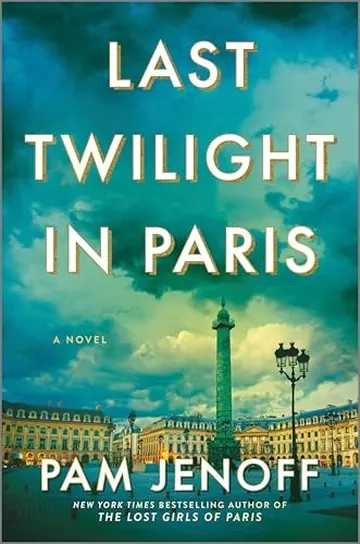
The first page of Last Twilight in Paris
Darkness.
Helaine stumbled forward, unable to see through the black void that surrounded her. She could feel the shoulders of the others jostling on either side. The smell of unwashed bodies rose, mingling with Helaine’s own. Her hand brushed against a rough wall, scraping her knuckles. Someone ahead tripped and yelped.
Hours earlier, when Helaine had been brought from her underground cell at the police station into the adjacent holding area, she was surprised to see other women waiting. She had not encountered anyone since her arrest. She had studied the women, who looked to be from all walks of life, trying to discern some commonality among their varied ages and classes that had caused them to be here. There was only one: they were Jews. The yellow star they wore, whether soiled and crudely sewn onto a worn, secondhand dress or pressed crisply against the latest Parisian finery, was identical—and it made them all the same.
Continue reading
They had stood in the bare holding area, not daring to speak. Helaine was certain that her arrest had been some sort of mistake. She had done nothing wrong. They had to free her. But even as she thought this, she knew that the old world of being a French citizen with rights was long gone.
An hour passed, then two. There was nowhere to sit, and a few people dropped to the floor. An elderly woman dozed against the wall, mouth agape. Except for the slight rise and fall of her chest, she might have been dead. Hunger gnawed at Helaine and she wished that she still had the baked goods she purchased at the market just before she was taken. The meager breads, which had seemed so pathetic days earlier, now would have been a feast. But her belongings had been confiscated upon arrest.
Helaine looked upward through the thin slit of window near the ceiling. They were still in Paris. The sour smell from the city street and the sounds of cars and footsteps despite the curfew were familiar, if not comforting. How long they would stay here, she did not know. Helaine was torn. She did not want to remain in this empty room forever. Yet she also dreaded leaving, for wherever they were going would surely be worse.
Finally, the door had opened. “Sortir!” a voice ordered them out in French, reminding Helaine that the policemen, who had brought them here and who were keeping them captive, were not Germans, but their own people.
Helaine had filed into the dimly lit corridor with the others. They exited the police station and stepped outside onto the pavement. At the sight of the familiar buildings and the street leading away from the station, Helaine momentarily considered fleeing. She had no idea, though, where she would go. She imagined running to her childhood home, debated whether her estranged mother would take her in or turn her away. But the women were heavily guarded and there was no real possibility of escape. Instead, Helaine breathed the fresh air in great gulps, sensing that she might not be in the open again for quite some time.
The women were herded up a ramp toward an awaiting truck. Helaine recoiled. They were being placed in the back part of the vehicle where goods should have been carried, not people. Helaine wanted to protest but did not dare. Smells of stale grain and rotting meat, the truck’s previous cargo, assaulted her nose, mixing with her own stench in the warm air. It had been three days since she had bathed or changed and her dress was wrinkled and filthy, her once-luminous black curls dull and matted against her head.
When the women were all inside the truck, the back hatch shut with an ominous click. “Where are they taking us?” someone whispered. Silence. No one knew and they were all too afraid to venture a guess. They had heard the stories of the trains headed east to awful places from which no one ever returned. Helaine wondered how long the journey would be.
As they bumped along the Paris streets, Helaine’s bones, already sore from sleeping on the hard prison cell floor, cried out in pain. Her mouth was dry and her stomach empty. She wanted water and a meal, a hot bath. She wanted home.
If home was a place that even existed anymore. Helaine’s husband, Gabriel, was missing in Germany, his fate unknown. She had scarcely spoken with her parents since before the war. And Helaine herself had been taken without notice. Nobody knew that she had been arrested or had any idea where she had gone. It was as if she simply no longer existed.
“Jenoff offers a piercing depiction of Jewish life in Paris under German occupation…”
Publishers Weekly
Content note: Holocaust, imprisonment of Jews
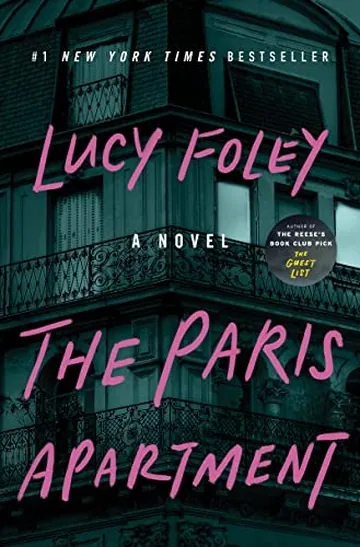
The first page of The Paris Apartment
His fingers hover over the keyboard. Got to get it all down. This: this is the story that’s going to make his name. Ben lights another cigarette, a Gitane. Bit of a cliché to smoke them here but he does actually like the taste. And fine, yeah, likes the way he looks smoking them too.
He’s sitting in front of the apartment’s long windows, which look onto the central courtyard. Everything out there is steeped in darkness, save for the weak greenish glow thrown by a single lamp. It’s a beautiful building, but there’s something rotten at its heart. Now he’s discovered it he can smell the stench of it everywhere.
He should be clearing out of here soon. He’s outstayed his welcome in this place. Jess could hardly have chosen a worse time to decide to come and stay. She barely gave him any notice. And she didn’t give much detail on the phone but clearly something’s up; something wrong with whatever crappy bar job she’s working now. His half sister has a knack for turning up when she’s not wanted. She’s like a homing beacon for trouble: it seems to follow her around. She’s never been good at just playing the game. Never understood how much easier it makes life if you just give people what they want, tell them what they want to hear. Admittedly, he did tell her to come and stay “whenever you like,” but he didn’t really mean it. Trust Jess to take him at his word.
Continue reading
When was the last time he saw her? Thinking about her always makes him feel guilty. Should he have been there for her more, looked out for her ... ? She’s fragile, Jess. Or—not fragile exactly, but vulnerable in a way people probably don’t see at first. An “armadillo”: softness beneath that tough exterior.
Anyway. He should call her, give her some directions. When her phone rings out he leaves a voicenote: “Hey Jess, so it’s number twelve, Rue des Amants. Got that? Third floor.”
His eye’s drawn to a flash of movement in the courtyard beneath the windows. Someone’s passing through it quickly.
Almost running. He can only make out a shadowy figure, can’t see who it is. But something about the speed seems odd. He’s hit with a little animal spike of adrenaline.
He remembers he’s still recording the voicenote, drags his gaze from the window. “Just ring the buzzer. I’ll be up waiting for you—”
He stops speaking. Hesitates, listens.
A noise.
The sound of footsteps out on the landing ... approaching the apartment door.
The footsteps stop. Someone is there, just outside. He waits for a knock. None comes. Silence. But a weighted silence, like a held breath.
Odd.
And then another sound. He stands still, ears pricked, listening intently. There it is again. It’s metal on metal, the scrape of a key. Then the clunk of it entering the mechanism. He watches the lock turn. Someone is unlocking his door from the outside. Someone who has a key, but no business coming in here uninvited.
The handle begins to move downward. The door begins to open, with that familiar drawn-out groan.
He puts his phone down on the kitchen counter, voicenote forgotten. Waits and watches dumbly as the door swings forward.
As the figure steps into the room.
“What are you doing here?” he asks. Calm, reasonable. Nothing to hide. Not afraid. Or not yet. “And why—”
Then he sees what his intruder holds.
Now. Now the fear comes.
“Foley reliably entertains.”
Publishers Weekly
Questions
Quick answers
Which ones are set during the Second World War?
Two. The Paris Library follows a young librarian at the American Library under German occupation, and Last Twilight in Paris centers on Lévitan, a department store the Nazis turned into a work camp.