Books set in Italy, from a medieval abbey to the Amalfi Coast
An abbey in 1327, a Medici daughter married into Ferrara, Rome in the year of four emperors and Rome today, a duck hunt near Venice and a summer in Positano. Read the first page of each.

The first page of The Name of the Rose
On August 16, 1968, I was handed a book written by a certain Abbé Vallet, Le Manuscrit de Dom Adson de Melk, traduit en français d'après l'édition de Dom J. Mabillon (Aux Presses de l'Abbaye de la Source, Paris, 1842). Supplemented by historical information that was actually quite scant, the book claimed to reproduce faithfully a fourteenth-century manuscript that, in its turn, had been found in the monastery of Melk by the great eighteenth-century man of learning, to whom we owe so much information about the history of the Benedictine order. The scholarly discovery (I mean mine, the third in chronological order) entertained me while I was in Prague, waiting for a dear friend. Six days later Soviet troops invaded that unhappy city. I managed, not without adventure, to reach the Austrian border at Linz, and from there I journeyed to Vienna, where I met my beloved, and together we sailed up the Danube.
Continue reading
In a state of intellectual excitement, I read with fascination the terrible story of Adso of Melk, and I allowed myself to be so absorbed by it that, almost in a single burst of energy, I completed a translation, using some of those large notebooks from the Papeterie Joseph Gibert in which it is so pleasant to write if you use a felt-tip pen. And as I was writing, we reached the vicinity of Melk, where, perched over a bend in the river, the handsome Stift stands to this day, after several restorations during the course of the centuries. As the reader must have guessed, in the monastery library I found no trace of Adso’s manuscript.
Before we reached Salzburg, one tragic night in a little hotel on the shores of the Mondsee, my traveling-companionship was abruptly interrupted, and the person with whom I was traveling disappeared—taking Abbé Vallet’s book, not out of spite, but because of the abrupt and untidy way in which our relationship ended. And so I was left with a number of manuscript notebooks in my hand, and a great emptiness in my heart.
A few months later, in Paris, I decided to get to the bottom of my research. Among the few pieces of information I had derived from the French book, I still had the reference to its source, exceptionally detailed and precise:
VETERA ANALECTA, Sive COLLECTIO VETERUM ALIQUOT OPERUM & Opusculorum omnis generis, Carminum, Epistolarum, Diplomatum, Epitaphiorum, & CUM ITINERE GERMANICO, Annotationibus & aliquot disquisitionibus R.P.D. Joannis Mabillon, Presbiteri ac Monachi Ord. Sancti Benedicti e Congregatione S. Mauri.—NOVA EDITIO, Cui accessere MABILLONII Vita & aliquot opuscula, scilicet Dissertatio de PANE EUCHARISTICO, AZYMO ET FERMENTATO, ad Eminentiss. Cardinalem BONA. Subjungitur opusculum ELDERONSI Hispaniensis Episcopi de eodem argumento ET EUSEBII Romani ad THEOPHILUM Gallum epistola, DE CULTU SANCTORUM IGNOTORUM. Parisiis, apud Levesque, ad Pontem S. Michaelis, MDCCXXI, cum privilegio Regis.
I quickly found the Vetera analecta at the Bibliothèque Sainte Geneviève, but to my great surprise the edition I came upon differed from the description in two details: first, the publisher, who was given here as “Montalant, ad Ripam P.P. Augustinianorum (prope Pontem S. Michaelis),” and also the date, which was two years later. I needn’t add that these analecta did not comprehend any manuscript of Adso or Adson of Melk; on the contrary, as anyone interested can check, they are a collection of brief or medium-length texts, whereas the story transcribed by Vallet ran to several hundred pages.
“…a series of murders at a mythical Benedictine abbey somewhere near the Ligurian coast in 1327…”
Kirkus Reviews

The first page of The Marriage Portrait
Lucrezia is taking her seat at the long dining table, which is polished to a watery gleam and spread with dishes, inverted cups, a woven circlet of fir. Her husband is sitting down, not in his customary place at the opposite end but next to her, close enough that she could rest her head on his shoulder, should she wish; he is unfolding his napkin and straightening a knife and moving the candle towards them both when it comes to her with a peculiar clarity, as if some coloured glass has been put in front of her eyes, or perhaps removed from them, that he intends to kill her.
She is sixteen years old, not quite a year into her marriage. They have travelled for most of the day, using what little daylight the season offers, leaving Ferrara at dawn and riding out to what he had told her was a hunting lodge, far in the north-west of the province.
Continue reading
But this is no hunting lodge, is what Lucrezia had wanted to say when they reached their destination: a high-walled edifice of dark stone, flanked on one side by dense forest and on the other by a twisting meander of the Po river. She would have liked to turn in her saddle and ask, why have you brought me here?
In 1560, fifteen-year-old Lucrezia di Cosimo de’ Medici left Florence to begin her married life with Alfonso II d’Este, Duke of Ferrara.
Less than a year later, she would be dead.
The official cause of her death was given as “putrid fever,” but it was rumoured that she had been murdered by her husband.
She said nothing, however, allowing her mare to follow him along the path, through dripping trees, over the arch-backed bridge and into the courtyard of the strange, fortified, star-shaped building, which seemed, even then, to strike her as peculiarly empty of people.
The horses have been led away, she has removed her sodden cloak and hat, and he has watched her do this, standing with his back to the blaze in the grate, and now he is gesturing to the country servants in the hall’s outer shadows to step forward and place food on their plates, to slice the bread, to pour wine into their cups, and she is suddenly recalling the words of her sister-in-law, delivered in a hoarse whisper: You will be blamed.
Lucrezia’s fingers grip the rim of her plate. The certainty that he means her to die is like a presence beside her, as if a dark-feathered bird of prey has alighted on the arm of her chair.
This is the reason for their sudden journey to such a wild and lonely place. He has brought her here, to this stone fortress, to murder her.
Astonishment yanks her up out of her body and she almost laughs; she is hovering by the vaulted ceiling, looking down at herself and him, sitting at the table, putting broth and salted bread into their mouths. She sees the way he leans towards her, resting his fingers on the bare skin of her wrist as he says something; she watches herself nodding at him, swallowing the food, speaking some words about their journey here and the interesting scenery through which they passed, as if nothing at all is amiss between them, as if this is a normal dinner, after which they will retire to bed.
“A compelling portrait of a young woman out of step with her times.”
Kirkus Reviews
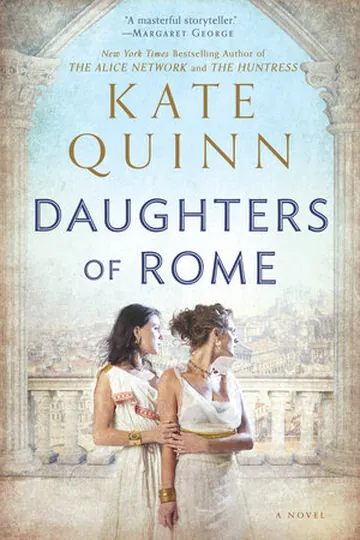
The first page of Daughters of Rome
A hand.
Just a little girl’s hand like any other, plump-fingered and a little sticky, but for a moment he saw blood all over it.
“Interesting,” Nessus gulped. The girl stared up at him, expectant, and he looked at her palm again, hoping it had been a trick of the light. Maybe a shadow. But no, there it was: not a shadow but blood.
You’re seeing things, he told himself. You’re seeing things.
“What?” the child said, curious.
He swallowed a sudden burst of nervous laughter. Wasn’t an astrologer supposed to see things when he looked at the stars, or into a palm?
But he never had before, not once since he’d gotten started in this business. Astrology wasn’t about truth, after all—it was about pleasing the clients. Telling pregnant women that their stars foretold healthy sons; telling legionaries their futures held medals and glory. What successful astrologer told anybody there was enough blood in their hand to soak all Rome?
Continue reading
I could have run a wine shop. The sun was hot overhead, but Nessus felt chill sweat start to creep down his neck. I could have become a trader. But no, I had to become an astrologer. Reading stars, reading palms when business gets slow, oh, why didn’t I just open a wine shop? The only blood anybody saw in a wine shop came from drunks giving each other a swollen nose.
And the morning had started with such promise. Nessus had come early to the Forum Romanum, staking himself a place on the shady side where the afternoon sun wouldn’t beat down on his head like Vulcan’s hammer, and laid out his little display of star charts on threadbare silk. By noon he’d been commissioned for three horoscopes (payment on delivery), read the palm of a grain merchant and spoke mysteriously of fat profits coming on the next harvest; squinted at the hand of a giddy young woman and whispered of a rich husband.
Nessus had just been mopping his already balding forehead on his sleeve and contemplating a jug of wine at the nearest tavern when four little girls arrayed themselves expectantly before him.
“We want you to read our futures,” the tallest had announced, and the rest promptly collapsed into giggles.
“There’s no time,” their nursemaid scolded, but Nessus looked them over with a practiced eye. Patrician girls, or he’d eat his straw sun hat: silk dresses, tooled leather sandals, veils over their hair to shield their skin. And patrician girls, even little ones like these, had coins to spend.
“Such futures ahead of you!” he intoned mysteriously. “Your stars sing to me of fame and fortune, beauty and love . . . two sesterces apiece, and cheap at the price. Which of you first?”
“Me, me!” Four hands presented themselves, variously grubby.
“No, me first, I’m the oldest! I’m Cornelia Prima, and that’s my sister, she’s Cornelia Secunda, and that’s Cornelia Tertia and Cornelia Quarta, they’re our cousins—
Definitely patricians—only patricians had such a complete lack of imagination when it came to naming their daughters. Four girls born to one clan—undoubtedly the Cornelii!—and as was traditional, they’d all just been named Cornelia and then numbered in order.
“Readers will become thoroughly immersed in this chaotic period of Roman history.”
Publishers Weekly

The first page of Across the River and Into the Trees
They started two hours before daylight, and at first, it was not necessary to break the ice across the canal as other boats had gone on ahead. In each boat, in the darkness, so you could not see, but only hear him, the poler stood in the stern, with his long oar. The shooter sat on a shooting stool fastened to the top of a box that contained his lunch and shells, and the shooter's two, or more, guns were propped against the load of wooden decoys. Somewhere, in each boat, there was a sack with one or two live mallard hens, or a hen and a drake, and in each boat there was a dog who shifted and shivered uneasily at the sound of the wings of the ducks that passed overhead in the darkness. Four of the boats went on up the main canal toward the big lagoon to the north. A fifth boat had already turned off into a side canal. Now, the sixth boat turned south into a shallow lagoon, and there was no broken water. It was all ice, new-frozen during the sudden, windless cold of the night. It was rubbery and bending against the thrust of the boatman’s oar. Then it would break as sharply as a pane of glass, but the boat made little forward progress.
Continue reading
“Give me an oar,” the shooter in the sixth boat said. He stood up and braced himself carefully. He could hear the ducks passing in the darkness, and feel the restless lurching of the dog. To the north he heard the sound of breaking ice from the other boats.
“Be careful,” the poler in the stern said. “Don’t tip the boat over.”
“I am a boatman, too,” the shooter said.
He took the long oar the boatman handed him and reversed it so he could hold it by the blade. Holding the blade he reached forward and punched the handle through the ice. He felt the firm bottom of the shallow lagoon, put his weight on the top of the wide oar-blade, and holding with both hands and, first pulling, then shoving, until the pole-hold was well to the stern, he drove the boat ahead to break the ice. The ice broke like sheets of plate glass as the boat drove into it, and onto it, and astern the boatman shoved them ahead into the broken passage.
After a while, the shooter, who was working hard and steadily and sweating in his heavy clothes, asked the boatman, “Where is the shooting barrel?”
“Off there to the left. In the middle of the next bay.”
“Should I turn for it now?”
“As you wish.”
“What do you mean, as I wish? You know the water. Is there water to carry us there?”
“The tide is low. Who knows?”
“It will be daylight before we get there if we don’t hurry.”
The boatman did not answer.
All right, you surly jerk, the shooter thought to himself. We are going to get there. We’ve made two-thirds of the way now and if you are worried about having to work to break ice to pick up birds, that is altogether too bad.
“Get your back in it, jerk,” he said in English.
“What?” the boatman asked in Italian.
“I said let’s go. It’s going to be light.”
It was daylight before they reached the oaken staved hogshead sunk in the bottom of the lagoon.

The first page of Roman Stories
Every Saturday, a new family comes to stay. Some arrive early in the morning, from afar, ready to begin their vacation. Others don't turn up until sunset, in bad moods, maybe having lost their way. It's easy to get lost in these hills; the roads are poorly signposted.
Today, after they introduce themselves, I show them around. My mother used to do the welcoming. But she's spending the summer in a nearby town, helping out an elderly gentleman who's also on vacation, so I have to do it.
As usual, there are four of them: mother, father, two daughters. They follow me, wide-eyed, happy to stretch their legs.
We stop for a moment on the shaded patio that looks out over the lawn, under a thatched roof that filters the light. There are two armchairs and a sofa, covered with white fabric, lounge chairs for sunbathing, and a wooden table big enough for ten people.
Continue reading
I open the sliding glass door and show them inside: the cozy living room with two comfortable sofas in front of the fireplace, the well-stocked kitchen, two bedrooms.
While the father unloads the car and the girls, who are probably around seven and nine, disappear into their room, shutting the door behind them, I tell the mother where to find extra towels, and woolen blankets, in case it gets cold at night.
I show her where the mouse poison is hidden. Kill the flies before going to bed, I suggest, otherwise they start buzzing at dawn and become a nuisance. I explain how to get to the supermarket, how to use the washing machine behind the house, and where to hang the laundry, just on the other side of my father’s garden.
Guests are free to pick lettuce and tomatoes, I add. There were lots of tomatoes this year, but most of them spoiled in the July rain.
I pretend not to watch them, to be discreet. I do the housework and water the garden, but I can’t help noticing how happy and excited they are. I hear the girls’ voices as they run across the lawn, I learn their names. Since the guests usually leave the sliding door open, I overhear what the parents say to each other as they settle into the house, as they unpack their suitcases and decide what to have for lunch.
The cottage where my family lives is a few yards away, behind a tall hedge that forms a kind of screen. For years, our house was just a room that served as both kitchen and bedroom for the three of us. Then, two years ago, when I turned thirteen, my mother started working for the elderly gentleman, and, after saving up enough money, my parents asked the man who owns the property if they could add a small room for me—where stubby lizards slip through cracks between the wall and ceiling.
My father is the caretaker. He looks after the big house, chops wood, works the fields and the vineyard. He looks after the horses, which the owner loves with a passion.
The owner lives abroad, but he’s not a foreigner like us. He comes every now and then, on his own. He doesn’t have a family. During the days he goes horseback riding; in the evenings he reads in front of the fireplace. Then he goes away again.
Not many people rent his house other than in summer. The winters here are biting, and in the spring there’s lots of rain. In the mornings, from September to June, my father drives me to school, where I feel out of place. I don’t mix easily with others; I don’t look like anyone else.
The girls in this family resemble each other. You can tell right away that they’re sisters. They’ve already put on matching bathing suits to go to the beach later on. The beach is about fifteen miles from here. The mother looks like a girl, too. She’s small and thin, she wears her long hair loose. Her shoulders are delicate. She walks barefoot on the grass even though the father tells her not to, saying (and he’s right) that there might be porcupines, hornets, snakes.
“Filled with intelligence and sorrow, these sharply drawn glimpses of Roman lives create an impressively unified effect.”
Kirkus Reviews
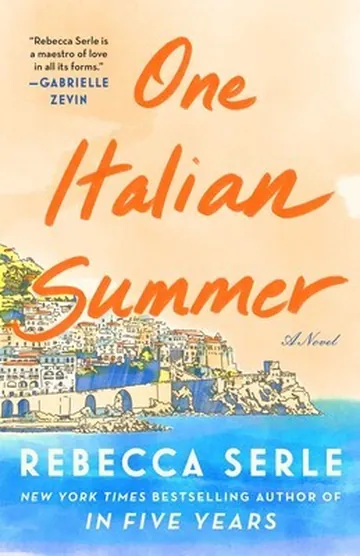
The first page of One Italian Summer
I've never smoked, but it's the last day of my mother's shiva, so here we are. I have the cigarette between my teeth, standing on the back patio, looking at what was, just two months ago, a pristine white sectional, now weatherworn. My mother kept everything clean. She kept everything.
Carol's rules to live by:
• Never throw away a good pair of jeans.
• Always have fresh lemons on hand.
• Bread keeps for a week in the fridge and two months in the freezer.
• OxiClean will take out any stain.
• Be careful of bleach.
• Linen is better than cotton in the summer.
• Plant herbs, not flowers.
• Don't be afraid of paint. A bold color can transform a room.
• Always arrive on time to a restaurant and five minutes late to a house.
• Never smoke.
I should say, I haven't actually lit it.
Carol Almea Silver was a pillar of the community, beloved by everyone she encountered. In the past week, we have opened our doors to sales associates and manicurists, the women from her temple, waiters from Craig's, nurses from Cedars-Sinai. Two bank tellers from the City National branch on Roxbury. “She used to bring us baked goods,” they said. “She was always ready with a phone number.” There are couples from the Brentwood Country Club. Irene Newton, who had a standing lunch with my mother at Il Pastaio every Thursday. Even the bartender from the Hotel Bel-Air, where Carol used to go for an ice-cold martini. Everyone has a story.
Continue reading
My mother was the first person you called for a recipe (a cup of onions, garlic, don't forget the pinch of sugar) and the last one you called at night when you just couldn't sleep (a cup of hot water with lemon, lavender oil, magnesium pills). She knew the exact ratio of olive oil to garlic in any recipe, and she could whip up dinner from three pantry items, easy. She had all the answers. I, on the other hand, have none of them, and now I no longer have her.
“Hi,” I hear Eric say from inside. “Where is everyone?”
Eric is my husband, and he is our last guest here today. He shouldn't be. He should have been with us the entire time, in the hard, low chairs, stuck between noodle casseroles and the ringing phone and the endless lipstick kisses of neighbors and women who call themselves aunties, but instead he is here in the entryway to what is now my father's house, waiting to be received.
I close my eyes. Maybe if I cannot see him, he will stop looking for me.
“An unconventional love story that embraces people’s flaws and selfishness as part of what makes them human.”
Kirkus Reviews
Questions
Quick answers
Do any of them open somewhere else?
Two do. The Name of the Rose begins with a framing preface set in 1968, before it reaches the abbey, and One Italian Summer opens at home, before the trip.