Books like Stephen King, from a ghost bought online to a Scout troop
Six horror novels for King readers, two of them by his son, Joe Hill: a rock star who buys a dead man’s suit, a man who takes children to Christmasland, a girl whose exorcism is filmed for television, a Scout troop off Prince Edward Island, three mercenaries at a religious compound and a slasher fan in Proofrock, Idaho. Read the first page of each.

The first page of Heart-Shaped Box
Jude had a private collection.
He had framed sketches of the Seven Dwarfs on the wall of his studio, in between his platinum records. John Wayne Gacy had drawn them while he was in jail and sent them to him. Gacy liked golden-age Disney almost as much as he liked molesting little kids; almost as much as he liked Jude’s albums.
Jude had the skull of a peasant who had been trepanned in the sixteenth century, to let the demons out. He kept a collection of pens jammed into the hole in the center of the cranium.
He had a three-hundred-year-old confession, signed by a witch. “I did spake with a black dogge who sayd hee wouldst poison cows, drive horses mad and sicken children for me if I wouldst let him have my soule, and I sayd aye, and after did give him sucke at my breast.” She was burned to death.
Continue reading
He had a stiff and worn noose that had been used to hang a man in England at the turn of the nineteenth century, Aleister Crowley’s childhood chessboard, and a snuff film. Of all the items in Jude’s collection, this last was the thing he felt most uncomfortable about possessing. It had come to him by way of a police officer, a man who had worked security at some shows in L.A. The cop had said the video was diseased. He said it with some enthusiasm. Jude had watched it and felt that he was right. It was diseased. It had also, in an indirect way, helped hasten the end of Jude’s marriage. Still he held on to it.
Many of the objects in his private collection of the grotesque and the bizarre were gifts sent to him by his fans. It was rare for him to actually buy something for the collection himself. But when Danny Wooten, his personal assistant, told him there was a ghost for sale on the Internet and asked did he want to buy it, Jude didn’t even need to think. It was like going out to eat, hearing the special, and deciding you wanted it without even looking at the menu. Some impulses required no consideration.
Danny’s office occupied a relatively new addition, extending from the northeastern end of Jude’s rambling, 110-year-old farmhouse. With its climate control, OfficeMax furniture, and coffee-and-cream industrial carpet, the office was coolly impersonal, nothing at all like the rest of the house. It might have been a dentist’s waiting room, if not for the concert posters in stainless-steel frames. One of them showed a jar crammed with staring eyeballs, bloody knots of nerves dangling from the backs of them. That was for the All Eyes On You tour.
No sooner had the addition been built than Jude had come to regret it. He had not wanted to drive forty minutes from Piecliff to a rented office in Poughkeepsie to see to his business, but that would’ve probably been preferable to having Danny Wooten right here at the house. Here Danny and Danny’s work were too close. When Jude was in the kitchen, he could hear the phones ringing in there, both of the office lines going off at once sometimes, and the sound was maddening to him. He had not recorded an album in years, had hardly worked since Jerome and Dizzy had died (and the band with them), but still the phones rang and rang.
“…a particularly merciless ghost…”
Publishers Weekly
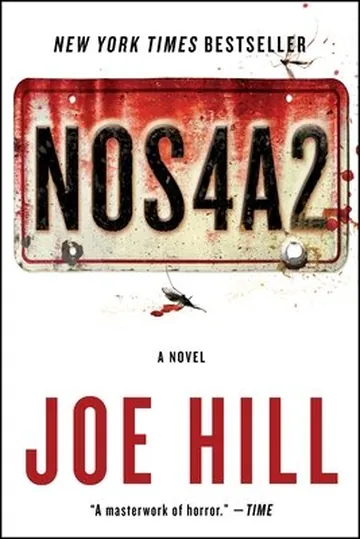
The first page of NOS4A2
Nurse Thornton dropped into the long-term-care ward a little before eight with a hot bag of blood for Charlie Manx. She was coasting on autopilot, her thoughts not on her work. She had finally made up her mind to buy her son, Josiah, the Nintendo DS he wanted, and was calculating whether she could get to Toys “R” Us after her shift, before they closed.
She had been resisting the impulse for a few weeks, on philosophical grounds. She didn’t really care if all his friends had one. She just didn’t like the idea of those handheld video-game systems that the kids carried with them everywhere. Ellen Thornton resented the way little boys disappeared into the glowing screen, ditching the real world for some province of the imagination where fun replaced thought and inventing creative new kills was an art form. She had fantasized having a child who would love books and play Scrabble and want to go on snowshoeing expeditions with her. What a laugh.
Continue reading
Ellen had held out as long as she could, and then, yesterday afternoon, she had come across Josiah sitting on his bed pretending an old wallet was a Nintendo DS. He had cut out a picture of Donkey Kong and slipped it into the clear plastic sleeve for displaying photographs. He pressed imaginary buttons and made explosion sounds, and her heart had hurt a little, watching him make believe he already had something he was certain he would get on the Big Day. Ellen could have her theories about what was healthy for boys and what wasn’t. That didn’t mean Santa had to share them. Because she was preoccupied, she didn’t notice what was different about Charlie Manx until she was easing around his cot to reach the IV rack. He happened to sigh heavily just then, as if bored, and she looked down and saw him staring up at her, and she was so startled to see him with his eyes open that she bobbled the sack of blood and almost dumped it on her feet.
He was hideous-old, not to mention hideous. His great bald skull was a globe mapping an alien moon, continents marked by liver spots and bruise-colored sarcomas. Of all the men in the long-term-care ward—a.k.a. the Vegetable Patch—there was something particularly awful about Charlie Manx with his eyes open at this time of year. Manx liked children. He’d made dozens of them disappear back in the nineties. He had a house below the Flatirons where he did what he liked with them and killed them and hung Christmas ornaments in their memory. The papers called the place the Sleigh House. Ho, ho, ho.
For the most part, Ellen could shut off the mother side of her brain while she was at work, could keep her mind away from thoughts of what Charlie Manx had probably done with the little girls and boys who had crossed his path, little girls and boys no older than her Josiah. Ellen didn’t muse on what any of her charges had done, if she could help it. The patient on the other side of the room had tied up his girlfriend and her two children, set fire to their house, and left them to burn. He was arrested in a bar down the street, drinking Bushmills and watching the White Sox play the Rangers. Ellen didn’t see how dwelling on it was ever going to do her any favors, and so she had taught herself to think of her patients as extensions of the machines and drip bags they were hooked up to: meat peripherals.
In all the time she’d been working at FCI Englewood, in the Supermax prison infirmary, she had never seen Charlie Manx with his eyes open. She’d been on staff for three years, and he had been comatose all that time. He was the frailest of her patients, a fragile coat of skin with bones inside. His heart monitor blipped like a metronome set to the slowest possible speed. The doc said he had as much brain activity as a can of creamed corn. No one had ever determined his age, but he looked older than Keith Richards. He even looked a little like Keith Richards—a bald Keith with a mouthful of sharp little brown teeth.
There were three other coma patients in the ward, what the staff called “gorks.” When you were around them long enough, you learned that all the gorks had their quirks. Don Henry, the man who burned his girl and her kids to death, went for “walks” sometimes. He didn’t get up, of course, but his feet pedaled weakly under the sheets. There was a guy named Leonard Potts who’d been in a coma for five years and was never going to wake up—another prisoner had jammed a screwdriver through his skull and into his brain. But sometimes he cleared his throat and would shout “I know!” as if he were a small child who wanted to answer the teacher’s question. Maybe opening his eyes was Manx’s quirk and she’d just never caught him doing it before.
“…it makes the skin crawl like a worm on a hot rock…”
Publishers Weekly

The first page of A Head Full of Ghosts
“This must be so difficult for you, Meredith.”
Best-selling author Rachel Neville wears a perfect fall ensemble: dark blue hat to match her sensible knee-length skirt and a beige wool jacket with buttons as large as kitten heads. She carefully attempts to keep to the uneven walkway. The slate stones have pitched up, their edges peeking out of the ground, and they wiggle under her feet like loose baby teeth. As a child I used to tie strings of red dental floss around a wiggly tooth and leave the floss dangling there for days and days until the tooth fell out on its own. Marjorie would call me a tease and chase me around the house trying to pull the wax string, and I would scream and cry because it was fun and because I was afraid if I let her pull out one tooth she wouldn’t be able to help herself and she’d pull them all out.
Continue reading
Has that much time really passed since we lived here? I’m only twenty-three but if anyone asks I tell them that I’m a quarter-century-minus-two years old. I like watching people struggle with the math in their heads.
I stay off the stones and walk across the neglected front yard, grown wild and unbounded in spring and summer, now beginning to retreat in the new cold of autumn. Leaves and weedy fingers tickle my ankles and grab at my sneakers. If Marjorie were here now, maybe she’d tell me a quick story about worms, spiders, and mice crawling underneath the decaying greenery, coming to get the young woman foolishly not keeping to the safety of the pathway.
Rachel enters the house first. She has a key and I don’t. So I hang back, peel a strip of white paint off the front door, and put it in my jeans pocket. Why shouldn’t I have a souvenir? It’s a souvenir that so many others have helped themselves to by the looks of the flaking door and dandruffed front stoop.
I didn’t realize how much I missed the place. I can’t get over how gray it looks now. Was it always this gray?
“Tremblay expertly ratchets up the suspense until the tension is almost at its breaking point.”
Kirkus Reviews
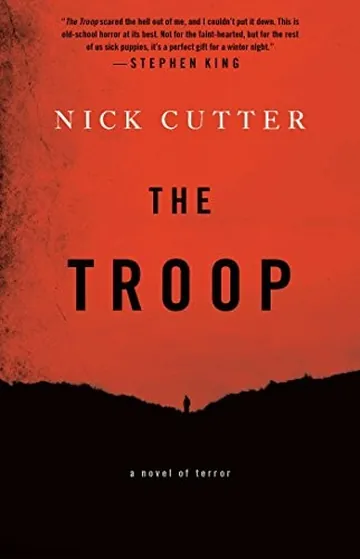
The first page of The Troop
Fearsome news, dear readers, from one of our loneliest outposts—the tiny fishing community of Lower Montague, Prince Edward Island. A forlorn, foreboding spike of rock projecting into the Atlantic Ocean.
The perfect location for devilry, methinks? Thankfully for you, we have eyes and ears everywhere. We see all, we hear all.
Sadie Adkins, waitress at the Diplomat Diner in Lower Montague, had her late-model Chevrolet truck stolen from the restaurant’s lot last night by an unnaturally emaciated thief. Adkins placed a call to our toll-free tip line after her entreaties to local deputy dawgs were cruelly and maliciously rebuffed, deemed—and we quote—“ludicrous” and “insane.”
“I know who stole my damn truck,” Adkins told us. “Starvin’ Marvin.”
An unidentified male, with close-cropped hair and baggy clothing, entered the Diplomat at 9 p.m. According to Adkins, the man was in a severe state of malnourishment.
“Skinny! You wouldn’t believe,” Adkins told our intrepid truth-gatherers. “Never in my life have I seen a man so wasted away. But hungry.”
Continue reading
Adkins reports that the unidentified male consumed five Hungry Man Breakfast platters—each consisting of four eggs, three buttermilk pancakes, five rashers of bacon, sausage links, and toast.
“He ate us out of eggs,” Adkins said. “Just kept shoveling it in and asking for more. His belly must have swelled up tight as a drum. He . . . well, he . . . when I came back with his third platter, or maybe it was his fourth, I caught him eating the napkins. Ripping them out of the dispenser, chewing and swallowing them.”
The unidentified man paid his bill and left. Shortly thereafter Adkins went outside to find her truck stolen—yet another malicious indignity!
“I can’t say I was too surprised,” she said. “The man seemed desperate in every way a man can possibly be desperate.”
She fell silent again before adding one final grisly detail:
“I could hear something coming from inside him—I’m saying, under his skin. I know that sounds silly.”
The unidentified man remains at large. Who is he? Where did he come from? The people who know—and longtime readers know who we’re talking about: the government, the Secret Service, the Templars, the Illuminati, the usual shady suspects aren’t forthcoming with info . . . but we’re beating the bushes and scouring secret files, investigating every legitimate tip that arrives at our tipline.
Something evil is afoot in sleepy Prince County. No man can be that hungry:
EAT EAT EAT EAT
The boat skipped over the waves, the drone of its motor trailing across the Gulf of Saint Lawrence. The moon was a bone fishhook in the clear October sky.
The man was wet from the spray that kicked over the gunwale. The outline of his body was visible under his drenched clothes. He easily could have been mistaken for a scarecrow left carelessly unattended in a farmer’s field, stuffing torn out by scavenging animals.
He’d stolen the boat from a dock at North Point, at the farthest tip of Prince Edward Island, reaching the dock in a truck he’d hotwired in a diner parking lot.
Christ, he was hungry. He’d eaten so much at that roadside diner that he’d ruptured his stomach lining—the contents of his guts were right now leaking through the split tissue, into the crevices between his organs. He wasn’t aware of that fact, though, and wouldn’t care much anyway in his current state. It’d felt so good to fill the empty space inside of him . . .
“Readers may wish to tackle this heart-pounding novel in highly populated, well-lit areas…”
Kirkus Reviews
Content note: graphic violence
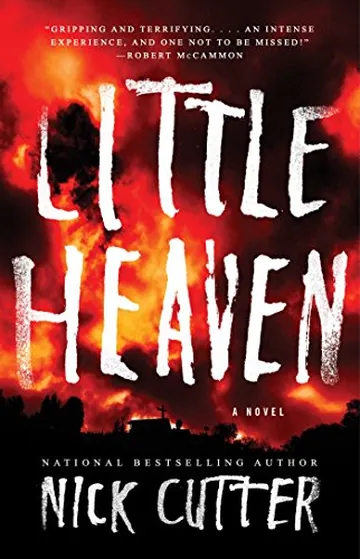
The first page of Little Heaven
There is a saying that goes: Evil never dies; it merely sleeps. And when that evil awakes, it can do so soundlessly—or almost so.
Even insects can scream.
The little aphid did, though at a register too high for any human ear to perceive. It toiled in the root system of a cactus plant growing on the edge of the New Mexico desert. An insect so small that it was practically invisible to the naked eye.
This was how it would begin again. The wheel coming around.
While the aphid fed on sugars deposited in the cactus roots, something curled up from the blackest recesses of the earth. It slipped inside the aphid’s body. If there was any pain—and yes, there would be—the insect was unable to articulate its agony beyond that thin scream.
The aphid trundled up the root stem, through the loose-packed sand, up onto one of the cactus’s fleshy leaves. There it encountered a honey ant, which fed on the honeydew that aphids produce.
Continue reading
Their antennae touched briefly: Whatever had stolen inside the aphid slipped soundlessly into the ant—something as inessential as the smoke billowing from the chimney of a charnel house.
The aphid erupted with a tiny pressurized hiss.
The ant returned to its hill, skittering through a fall of lemony afternoon sunlight. It disappeared down the hole. Shortly afterward, the hill emptied, ants pouring forth in furious multitudes.
The ants organized themselves in a skirmish line like soldiers on the march, and proceeded determinedly until they came to the burrow of a meadow mouse. They filed down the burrow, thousand upon thousand. There came an agonized squeal.
Presently the mouse emerged. It hopped and shook, its skin squirming. The mouse spun a few agitated circles before righting itself and dashing into the dry grass. It paused here and there to gnaw at its flesh, drawing blood. In time, it crossed paths with a desert shrew. Moments later there arose a high, mindless shriek.
The shrew encountered an opossum, which in turn encountered a black-tailed jackrabbit, which hurled itself screechingly into the jaws of a kit fox, which thrashed and gibbered and scurried into a den that housed a family of jaguarundis. More shrieks cresting across the arid expanse of sand.
Night fell over the desert. In the darkness, something shambled from the den. The moon touched upon its strange extrusions, its flesh shining wetly in the pale moonlight. It breathed through many mouths and gazed through a cluster of eyes lodged in a knot of fatted, blood-streaked fur. It locomoted on many legs, each of them foreshortened, compressed like the bellows of an accordion; the creature, whatever it was, scuttled in the manner of a crab. This abomination carried itself across the sands, moving stealthily, its quartet of snouts dilated to the breeze.
A solitary gray wolf sat on a rocky outcropping, scanning the mesa. An old wolf, much scarred, an ear torn off in some long-ago territorial battle. The wolf spotted movement. A shape shambled into view. This thing moved as though wounded, and yet the wolf’s predatory instincts said, No, no, no—this thing was not hurt. It was . . . something else.
The wolf loped off to investigate. It was wary but unafraid. If this other creature could bleed, the wolf would bleed it.
It had no fear. The wolf was apex. It had never encountered a creature that was its equal, not once in its long life.
“…this deeply disturbing story…”
Kirkus Reviews
Content note: graphic violence
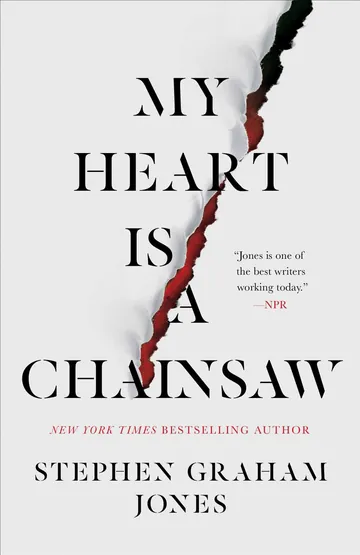
The first page of My Heart Is a Chainsaw
On the battered paper map that’s carried the two of them across they’re not sure how many of the American states now, this is Proofrock, Idaho, and the dark body of water before them is Indian Lake, and it kind of goes forever out into the night.
“Does that mean there’s Indians in the lake, or does it mean that Indians made it?” Lotte asks, a gleam of excitement to her eyes.
“Everything here’s named after Indians,” Sven says back, whispering because there’s something solemn about being awake when everyone’s asleep.
Their rental car is ticking down behind them from the six-hour push from Casper, the doors open because they just wanted to look, to see, to soak all this in before going back to the Netherlands at the end of the week.
Lotte shines her phone’s light down onto the fluttering map and looks up from it and across the water, like trying to connect what she’s seeing in lines and grids to what she’s actually standing in.
Continue reading
“Wat?” Sven says.
“In American,” Lotte tells him for the two-hundredth time. If they want partial course credit for immersion, they have to actually immerse.
“What?” Sven repeats, the word belligerent in English, like trying to make elbow room for itself.
“That should be the national forest on the other side,” Lotte says, chinning across the water because her hands are struggling to get the map shut.
“Everything’s a national forest,” Sven grumbles, angling his head as if to peer deeper into the darkness at all these black trees.
“But you can’t do that in the king’s forest, can you?” Lotte asks, finally getting the map folded in one of the six different ways it’s possible to fold it.
Sven follows her eyes across Indian Lake. There’s little floating pinpoints of light over there that only really come into focus when you look into the darkness right beside them.
“Hunh,” he says, Lotte coming up behind him to rest her chin on his shoulder, hold his waist in her hands.
Sven breathes in deep with wonder when the lights rearrange themselves, suggesting great yellow necks in the inky blackness: strange and massive animals, piecing the world together one lakeshore at a time. Then, a ways down the shore, a ball of flickering light arcs up into the velvety sky and hangs, hangs.
“Mooi,” Lotte says right next to his ear, and Sven repeats it in American: “Beautiful.”
“We shouldn’t,” Lotte says, which of course means the exact opposite.
Sven looks back to the car, shrugs sure, what the hell. It’s not like they’re going to be here again, right? It’s not like they’re going to get another chance to be twenty years old in America, a whole lake at their feet like it bubbled up just for them to dip their toes into—and maybe more.
“…expertly mixes the frightening and the funny…”
Publishers Weekly
Content note: graphic violence, suicide attempt
Questions
Quick answers
Which two are by Joe Hill?
Heart-Shaped Box, his first novel, and NOS4A2. Kirkus brings up King’s It in its review of the second.