Books like Emily Henry, where the banter is funny and the love story still hurts
Emily Henry’s rom-coms are funny, bookish and willing to hurt. Book Lovers sets the voice; these five bring their own: office enemies, a shared bed, a lake, a fake honeymoon, a lab.
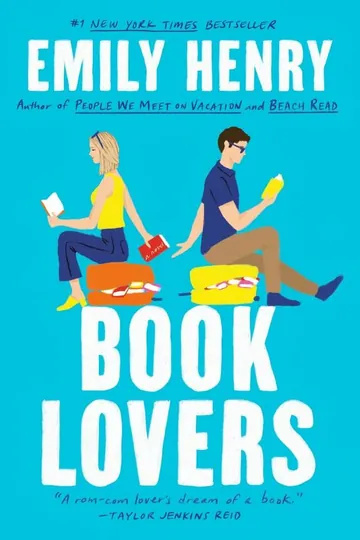
The first page of Book Lovers
When books are your life—or in my case, your job—you get pretty good at guessing where a story is going. The tropes, the archetypes, the common plot twists all start to organize themselves into a catalogue inside your brain, divided by category and genre.
The husband is the killer.
The nerd gets a makeover, and without her glasses, she's smoking hot.
The guy gets the girl—or the other girl does.
Someone explains a complicated scientific concept, and someone else says, "Um, in English, please?"
The details may change from book to book, but there's nothing truly new under the sun.
Take, for example, the small-town love story.
The kind where a cynical hotshot from New York or Los Angeles gets shipped off to Smalltown, USA—to, like, run a family-owned Christmas tree farm out of business to make room for a soulless corporation.
But while said City Person is in town, things don't go to plan. Because, of course, the Christmas tree farm—or bakery, or whatever the hero's been sent to destroy—is owned and operated by someone ridiculously attractive and suitably available for wooing.
Continue reading
Back in the city, the lead has a romantic partner. Someone ruthless who encourages him to do what he's set out to do and ruin some lives in exchange for that big promotion. He fields calls from her, during which she interrupts him, barking heartless advice from the seat of her Peloton bike.
You can tell she's evil because her hair is an unnatural blond, slicked back à la Sharon Stone in Basic Instinct, and also, she hates Christmas decorations.
As the hero spends more time with the charming baker/seamstress/tree farm person, things change for him. He learns the true meaning of life!
He returns home, transformed by the love of a good woman. There he asks his ice-queen girlfriend to take a walk with him. She gapes, says something like, In these Manolos?
It will be fun, he tells her. On the walk, he might ask her to look up at the stars.
She snaps, You know I can't look up right now!
I just got Botox!
And then he realizes: he can't go back to his old life. He doesn't want to! He ends his cold, unsatisfying relationship and proposes to his new sweetheart. (Who needs dating?)
At this point, you find yourself screaming at the book, You don't even know her! What's her middle name, bitch? From across the room, your sister, Libby, hushes you, throws popcorn at your head without lifting her gaze from her own crinkly-covered library book.
“A heartfelt and hilarious read about books, sisters, and writing your own love story.”
Kirkus Reviews
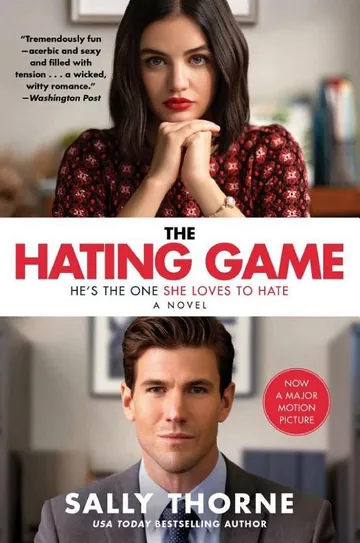
The first page of The Hating Game
I have a theory. Hating someone feels disturbingly similar to being in love with them. I've had a lot of time to compare love and hate, and these are my observations.
Love and hate are visceral. Your stomach twists at the thought of that person. The heart in your chest beats heavy and bright, nearly visible through your flesh and clothes. Your appetite and sleep are shredded. Every interaction spikes your blood with a dangerous kind of adrenaline, and you're on the brink of fight or flight. Your body is barely under your control. You're consumed, and it scares you.
Both love and hate are mirror versions of the same game—and you have to win. Why? Your heart and your ego. Trust me, I should know.
It’s early Friday afternoon. I’m imprisoned at my desk for another few hours. I wish I was in solitary confinement, but unfortunately I have a cellmate. Each tick of his watch feels like another tally mark, chipped onto the cell wall.
Continue reading
We’re engaged in one of our childish games, which requires no words. Like everything we do, it’s dreadfully immature.
The first thing to know about me: My name is Lucy Hutton. I’m the executive assistant to Helene Pascal, the co-CEO of Bexley & Gamin.
Once upon a time, our little Gamin Publishing was on the brink of collapse. The reality of the economy meant people had no money for their mortgage repayments and literature was a luxury. Bookstores were closing all over the city like candles being blown out. We braced ourselves for almost certain closure.
At the eleventh hour, a deal was struck with another struggling publishing house. Gamin Publishing was forced into an arranged marriage with the crumbling evil empire known as Bexley Books, ruled by the unbearable Mr. Bexley himself.
Each company stubbornly believing it was saving the other, they both packed up and moved into their new marital home. Neither party was remotely happy about it. The Bexleys remembered their old lunchroom foosball table with sepia-tinted nostalgia. They couldn’t believe the airy-fairy Gamins had survived even this long, with their lax adherence to key performance indicator targets and dreamy insistence on Literature as Art. The Bexleys believed numbers were more important than words. Books were units. Sell the units. High-five the team. Repeat.
The Gamins shuddered in horror watching their boisterous new stepbrothers practically tearing the pages out of their Brontës and Austens. How had Bexley managed to amass so many like-minded stuffed shirts, far more suited to accountancy or law? Gamins resented the notion of books as units. Books were, and always would be, something a little magic and something to respect.
One year on, you can still tell at a glance which company someone came from by his or her physical appearance. The Bexleys are hard geometrics, the Gamins are soft scribbles. Bexleys move in shark packs, talking figures and constantly hogging the conference rooms for their ominous Planning Sessions. Plotting sessions, more like. Gamins huddle in their cubicles, gentle doves in clock towers, poring over manuscripts, searching for the next literary sensation. The air surrounding them is perfumed with jasmine tea and paper. Shakespeare is their pinup boy.
The move to a new building was a little traumatizing, especially for the Gamins. Take a map of this city. Make a straight line between each of the old company buildings, mark a red dot exactly halfway between them and here we are. The new Bexley & Gamin is a cheap gray cement toad squatting on a major traffic route, impossible to merge onto in the afternoon. It’s arctic in the morning shadows and sweaty by the afternoon. The building has one redeeming feature: Some basement parking—usually snagged by the early risers, or should I say, the Bexleys.
Helene Pascal and Mr. Bexley had toured the building prior to the move and a rare thing happened: They both agreed on something. The top floor of the building was an insult. Only one executive office? A total refit was needed.
“Debut novelist Thorne delivers something nearly impossible: an entirely predictable plot that is also completely fresh, original, and utterly charming.”
Kirkus Reviews

The first page of The Flatshare
You’ve got to say this for desperation: It makes you much more open-minded.
I really can see some positives in this flat. The technicolor mold on the kitchen wall will scrub off, at least in the short term. The filthy mattress can be replaced fairly cheaply. And you could definitely make the argument that the mushrooms growing behind the toilet are introducing a fresh, outdoorsy feel to the place.
Gerty and Mo, however, are not desperate, and they are not trying to be positive. I would describe their expressions as “aghast.”
“You can’t live here.”
That’s Gerty. She’s standing with her heeled boots together and her elbows tucked in tight, as though occupying as little space as possible in protest at being here at all. Her hair is pulled back in a low bun, already pinned so she can easily slip on the barrister’s wig she wears for court. Her expression would be comical if it wasn’t my actual life we were discussing here.
Continue reading
“There must be somewhere else within budget, Tiff,” Mo says worriedly, bobbing up from where he was examining the boiler cupboard. He looks even more disheveled than usual, helped by the cobweb now hanging from his beard. “This is even worse than the one we viewed last night.”
I look round for the estate agent; he’s thankfully well out of earshot, smoking on the “balcony” (the sagging roof of the neighbor’s garage, definitely not designed for walking on).
“I’m not looking round another one of these hellholes,” Gerty says, glancing at her watch. It’s eight a.m.—she’ll need to be at Southwark Crown Court for nine. “There must be another option.”
“Surely we can fit her in at ours?” Mo suggests, for about the fifth time since Saturday.
“Honestly, would you stop with that?” Gerty snaps. “That is not a long-term solution. And she’d have to sleep standing up to even fit anywhere.” She gives me an exasperated look. “Couldn’t you have been shorter? We could have put you under the dining table if you were less than five nine.”
I make an apologetic face, but really I’d prefer to stay here than on the floor of the tiny, eye-wateringly expensive flat Mo and Gerty jointly invested in last month. They’ve never lived together before, even when we were at university. I’m concerned that it may well be the death of their friendship. Mo is messy, absentminded, and has this uncanny ability to take up an enormous amount of room despite being relatively small. Gerty, on the other hand, has spent the last three years living in a preternaturally clean flat, so perfect that it looks computer-generated. I’m not sure how the two lifestyles will overlay without West London imploding.
The main problem, though, is if I’m crashing on someone’s floor I can just as easily go back to Justin’s place. And, as of eleven p.m. Thursday, I have officially decided that I cannot be allowed that option any longer. I need to move forward, and I need to commit to somewhere so I can’t go back.
Mo rubs his forehead, sinking down into the grimy leather sofa. “Tiff, I could lend you some . . .”
“I don’t want you to lend me any money,” I say, more sharply than I mean to. “Look, I really need to get this sorted this week. It’s this place or the flatshare.”
“The bedshare, you mean,” Gerty says. “Can I ask why it has to be now? Not that I’m not delighted. Just that last I checked you were sitting tight in that flat waiting for the next time he-who-must-not-be-named deigned to drop by.”
I wince, surprised. Not at the sentiment—Mo and Gerty never liked Justin, and I know they hate that I’m still living at his place, even though he’s hardly ever there. It’s just unusual to hear Gerty bring him up directly.
“A warm, enchanting love story perfect for fans of classic rom-coms.”
Kirkus Reviews
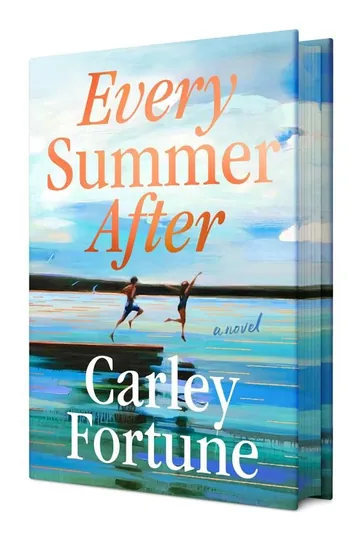
The first page of Every Summer After
The fourth cocktail had seemed like a good idea. So did the bangs, come to think of it. But now that I'm struggling to unlock my apartment door, I'm guessing I might regret that last spritz in the morning. Maybe the bangs, too. June told me breakup bangs were almost always a very bad choice when I sat in her chair for a cut today. But June wasn't going to her friend's engagement celebration, newly single, that night. Bangs were in order.
It's not that I'm still in love with my ex; I'm not. I never was. Sebastian is kind of a snob. An up-and-coming corporate lawyer, he wouldn't have lasted one hour at Chantal's party without scoffing at her choice of signature drink and referencing some pretentious article he read in the New York Times that declared Aperol spritzes "over." Instead, he would pretend to study the wine list, ask the bartender annoying questions about terroir and acidity and, regardless of the answers, go with a glass of the most expensive red. It’s not that he has exceptional taste or knows a lot about wine; he doesn’t. He just buys expensive stuff to give the impression of being discerning.
Continue reading
Sebastian and I were together for seven months, giving our relationship the distinction of being my longest-lasting one yet. In the end, he said he didn’t really know who I was. And he had a point.
Before Sebastian, the guys I picked were up for a good time and didn’t seem to mind keeping things casual. By the time I met him, I figured being a serious adult meant I should find someone to get serious about. Sebastian fit the bill. He was attractive, well read, and successful, and despite being a bit pompous, he could talk to anyone about almost anything. But I still found it hard to share too many pieces of myself. I’d long ago learned to tamp down my tendency to let random thoughts spew unfiltered from my mouth. I thought I was doing a good job of giving the relationship a real chance, but in the end Sebastian recognized my indifference, and he was right. I didn’t care about him. I didn’t care about any of them.
There was only the one.
And that one is long gone.
So I enjoy spending time with men, and I appreciate how sex gives me an escape ladder out of my mind. I like making men laugh, I like having company, I like taking a break from my vibrator once in a while, but I don’t get attached, and I don’t go deep.
I’m still fumbling with my key—seriously, is something wrong with the lock?—when my phone buzzes in my purse. Which is weird. No one calls me this late. Actually, no one ever calls me, except for Chantal and my parents. But Chantal is still at her party and my parents are touring Prague and won’t be awake yet. The buzzing stops just as I get the door open and stumble into my small one-bedroom apartment. I check the mirror by the entrance to find my lipstick mostly smudged off but my bangs looking pretty phenomenal. Suck it, June.
I begin to unfasten the strappy gold sandals I’m wearing, a dark sheet of hair falling over my face, when my phone starts up again. I dig it out of my purse and, one shoe off, make my way toward the couch, frowning at the “unknown name” message on the screen. Probably a wrong number.
“Hello?” I ask, bending to take off the second sandal.
“Is this Percy?”
I stand upright so fast I have to hold on to the arm of the couch to steady myself. Percy. It’s a name nobody calls me anymore. These days I’m Persephone to almost everyone. Sometimes I’m P. But I’m never Percy. I haven’t been Percy for years.
“Hello . . . Percy?” The voice is deep and soft.
“Alternating between the past and present, the story flawlessly conveys the lovers’ growth both together and apart…”
Publishers Weekly
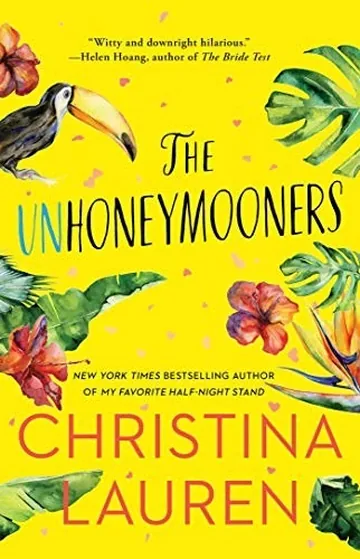
The first page of The Unhoneymooners
In the calm before the storm—in this case, the blessed quiet before the bridal suite is overrun by the wedding party—my twin sister stares critically down at a freshly painted shell-pink fingernail and says, “I bet you’re relieved I’m not a bridezilla.” She glances across the room at me and smiles generously. “I bet you expected me to be impossible.”
It is a statement so perfectly dropped in the moment, I want to take a picture and frame it. I share a knowing look with our cousin Julieta, who is repainting Ami’s toes (“It should be more petal pink than baby pink, don’t you think?”), and gesture to the bodice of Ami’s wedding gown—which hangs from a satin hanger and on which I am presently and painstakingly ensuring that every sequin is lying flat. “Define ‘bridezilla.’”
Ami meets my eyes again, this time with a half-hearted glare. She’s in her fancy wedding-bra contraption and skimpy underwear that I’m aware—with some degree of sibling nausea—her dudebro fiancé, Dane, will positively destroy later. Her makeup is tastefully done and her fluffy veil is pinned in her upswept dark hair. It’s jarring. I mean, we’re used to looking identical while knowing we’re wholly different people inside, but this is something entirely unfamiliar: Ami is the portrait of a bride. Her life suddenly bears no resemblance to mine whatsoever.
Continue reading
“I’m not a bridezilla,” she argues. “I’m a perfectionist.”
I find my list and hold it aloft, waving it to catch her attention. It’s a piece of heavy, scalloped-edged pink stationery that has Olive’s To-Do List—Wedding Day Edition written in meticulous calligraphy at the top, and which includes seventy-four (seventy-four) items ranging from Check for symmetry of the sequins on the bridal gown to Remove any wilted petals from the table arrangements.
Each bridesmaid has her own list, perhaps not quite as long as my maid-of-honor one but equally fancy and hand-written. Ami even drew checkboxes so that we can record when each task is completed.
“Some people might call these lists a little overboard,” I say.
“Those are the same ‘some people,’” she replies, “who’ll pay an arm and a leg for a wedding that is half as nice.”
“Right. They hire a wedding planner to—” I refer to my list. “Wipe condensation off the chairs a half hour before the ceremony.”
Ami blows across her fingernails to dry them and lets out a movie-villain laugh. “Fools.”
You know what they say about self-fulfilling prophecies, I’m sure. Winning makes you feel like a winner, and then somehow . . . you keep winning. It has to be true, because Ami wins everything. She tossed a ticket into a raffle bowl at a street fair and walked home with a set of community theater tickets. She slid her business card into a cup at The Happy Gnome and won free happy hour beers for a year. She’s won makeovers, books, movie premiere tickets, a lawnmower, endless T-shirts, and even a car. Of course, she also won the stationery and calligraphy set she used to write the to-do lists.
“Heartfelt and funny, this enemies-to-lovers romance shows that the best things in life are all-inclusive and nontransferable as well as free.”
Kirkus Reviews
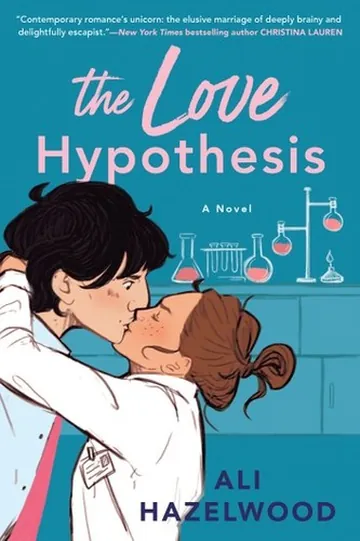
The first page of The Love Hypothesis
Frankly, Olive was a bit on the fence about this whole grad school thing.
Not because she didn’t like science. (She did. She loved science. Science was her thing.) And not because of the truckload of obvious red flags. She was well aware that committing to years of unappreciated, underpaid eighty-hour workweeks might not be good for her mental health. That nights spent toiling away in front of a Bunsen burner to uncover a trivial slice of knowledge might not be the key to happiness. That devoting her mind and body to academic pursuits with only infrequent breaks to steal unattended bagels might not be a wise choice.
She was well aware, and yet none of it worried her. Or maybe it did, a tiny bit, but she could deal. It was something else that held her back from surrendering herself to the most notorious and soul-sucking circle of hell (i.e., a Ph.D. program). Held her back, that is, until she was invited to interview for a spot in Stanford’s biology department, and came across The Guy.
Continue reading
The Guy whose name she never really got.
The Guy she met after stumbling blindly into the first bathroom she could find.
The Guy who asked her, “Out of curiosity, is there a specific reason you’re crying in my restroom?” Olive squeaked. She tried to open her eyes through the tears and only barely managed to. Her entire field of view was blurry. All she could see was a watery outline—someone tall, dark haired, dressed in black, and . . . yeah. That was it. “I . . . is this the ladies’ restroom?” she stammered.
A pause. Silence. And then: “Nope.” His voice was deep. So deep. Really deep. Dreamy deep.
“Are you sure?”
“Yes.”
“Really?”
“Fairly, since this is my lab’s bathroom.”
Well. He had her there. “I’m so sorry. Do you need to . . .” She gestured toward the stall, or where she thought the stalls were. Her eyes stung, even closed, and she had to scrunch them shut to dull the burn. She tried to dry her cheeks with her sleeve, but the material of her wrap dress was cheap and flimsy, not half as absorbent as real cotton. Ah, the joys of being impoverished.
“I just need to pour this reagent down the drain,” he said, but she didn’t hear him move. Maybe because she was blocking the sink. Or maybe because he thought Olive was a weirdo and was contemplating siccing the campus police on her. That would put a brutally quick end to her Ph.D. dreams, wouldn’t it? “We don’t use this as a restroom, just to dispose of waste and wash equipment.”
“Oh, sorry. I thought . . .” Poorly. She’d thought poorly, as was her habit and curse.
“Are you okay?” He must be really tall. His voice sounded like it came from ten feet above her.
“Sure. Why do you ask?”
“This smart, sexy contemporary should delight a wide swath of romance lovers.”
Publishers Weekly
Questions
Quick answers
What should I read after Emily Henry?
For roommates who share a flat but are never home at the same time, The Flatshare. For office enemies, The Hating Game. For a second-chance romance with a long history, Every Summer After.
Are there any with a literary or bookish setting?
Book Lovers is about a literary agent and an editor, and The Hating Game starts after two publishing companies merge. Emily Henry’s Happy Place is set at a cottage in coastal Maine; its first page is in the books set in Maine stack.