Books like All the Light We Cannot See, lives in the Second World War
All the Light We Cannot See opens as leaflets fall over Saint-Malo in 1944. These four stay close to people in the same war: a forger of papers in occupied France, jazz musicians in Berlin and Paris, two parachutists in Prague and a library in a London Tube station.
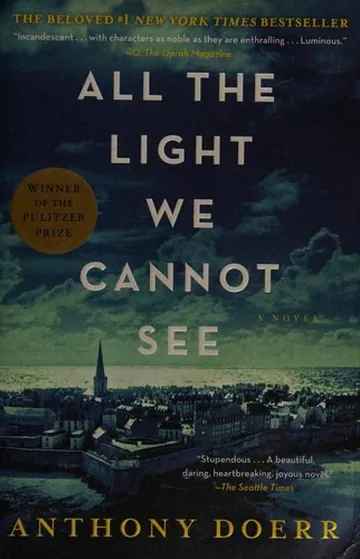
The first page of All the Light We Cannot See
At dusk they pour from the sky. They blow across the ramparts, turn cartwheels over rooftops, flutter into the ravines between houses. Entire streets swirl with them, flashing white against the cobbles. Urgent message to the inhabitants of this town, they say. Depart immediately to open country.
The tide climbs. The moon hangs small and yellow and gibbous. On the rooftops of beachfront hotels to the east, and in the gardens behind them, a half-dozen American artillery units drop incendiary rounds into the mouths of mortars.
They cross the Channel at midnight. There are twelve and they are named for songs: Stardust and Stormy Weather and In the Mood and Pistol-Packin’ Mama. The sea glides along far below, spattered with the countless chevrons of whitecaps. Soon enough, the navigators can discern the low moonlit lumps of islands ranged along the horizon. France.
Intercoms crackle. Deliberately, almost lazily, the bombers shed altitude. Threads of red light ascend from anti-air emplacements up and down the coast. Dark, ruined ships appear, scuttled or destroyed, one with its bow shorn away, a second flickering as it burns. On an outermost island, panicked sheep run zigzagging between rocks.
Continue reading
Inside each airplane, a bombardier peers through an aiming window and counts to twenty. Four five six seven. To the bombardiers, the walled city on its granite headland, drawing ever closer, looks like an unholy tooth, something black and dangerous, a final abscess to be lanced away.
In a corner of the city, inside a tall, narrow house at Number 4 rue Vauborel, on the sixth and highest floor, a sightless sixteen-year-old named Marie-Laure LeBlanc kneels over a low table covered entirely with a model. The model is a miniature of the city she kneels within, and contains scale replicas of the hundreds of houses and shops and hotels within its walls. There’s the cathedral with its perforated spire, and the bulky old Château de Saint-Malo, and row after row of seaside mansions studded with chimneys. A slender wooden jetty arcs out from a beach called the Plage du Môle; a delicate, reticulated atrium vaults over the seafood market; minute benches, the smallest no larger than apple seeds, dot the tiny public squares.
Marie-Laure runs her fingers along the centimeter-wide parapet crowning the ramparts, drawing an uneven star shape around the entire model. She finds the opening atop the walls where four ceremonial cannons point to sea. “Bastion de la Hollande,” she whispers, and her fingers walk down a little staircase. “Rue des Cordiers. Rue Jacques Cartier.”
In a corner of the room stand two galvanized buckets filled to the rim with water. Fill them up, her great-uncle has taught her, whenever you can. The bathtub on the third floor too. Who knows when the water will go out again.
Her fingers travel back to the cathedral spire. South to the Gate of Dinan. All evening she has been marching her fingers around the model, waiting for her great-uncle Etienne, who owns this house, who went out the previous night while she slept, and who has not returned. And now it is night again, another revolution of the clock, and the whole block is quiet, and she cannot sleep.
“Doerr captures the sights and sounds of wartime and focuses, refreshingly, on the innate goodness of his major characters.”
Kirkus Reviews
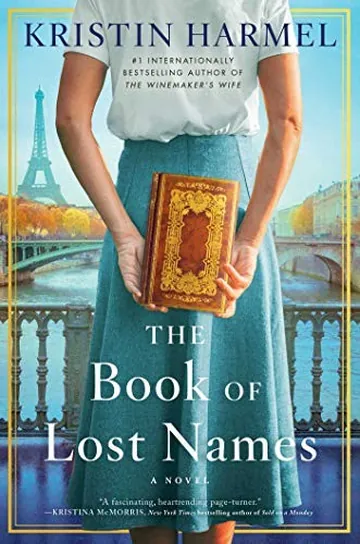
The first page of The Book of Lost Names
It’s a Saturday morning, and I’m midway through my shift at the Winter Park Public Library when I see it.
The book I last laid eyes on more than six decades ago.
The book I believed had vanished forever.
The book that meant everything to me.
It’s staring out at me from a photograph in the New York Times, which someone has left open on the returns desk. The world goes silent as I reach for the newspaper, my hand trembling nearly as much as it did the last time I held the book. “It can’t be,” I whisper.
I gaze at the picture. A man in his seventies looks back at me, his snowy hair sparse and wispy, his eyes froglike behind bulbous glasses.
“Sixty Years After End of World War II, German Librarian Seeks to Reunite Looted Books with Rightful Owners,” declares the headline, and I want to cry out to the man in the image that I am the rightful owner of the book he’s holding, the faded leather-bound volume with the peeling bottom right corner and the gilded spine bearing the title Epitres et Evangiles. It belongs to me—and to Rémy, a man who died long ago, a man I vowed after the war to think of no more.
Continue reading
But he’s been in my thoughts this week anyhow, despite my best efforts. Tomorrow, the eighth of May, the world will celebrate the sixtieth anniversary of Victory in Europe Day. It’s impossible, with all the young newscasters speaking solemnly of the war as if they could conceivably understand it, not to think of Rémy, not to think of the time we spent together then, not to think of the people we saved and the way it all ended. Though my son tells me I’m blessed to have such a sharp mind in my old age, like many blessings this one is mixed.
Most days, I just long to forget.
I blink away the uninvited thoughts of Rémy and return my attention to the article. The man in the photo is Otto Kühn, a librarian from the Zentralund Landesbibliothek in Berlin, who has made it his life’s mission to return books looted by the Nazis. There are apparently more than a million such books in his library’s collection alone, but the one he’s holding in the photo—my book—is the one he says keeps him up at night.
“This religious text,” Kühn has told the reporter, “is my favorite among the many mysteries that occupy our shelves. Published in Paris in 1732, it’s a very rare book, but that’s not what makes it extraordinary. It is unique because within it, we find an intriguing puzzle: some sort of code. To whom did it belong? What does the code mean? How did the Germans come to possess it during the war? These are the questions that haunt me.”
I feel tears in my eyes, tears that have no place there. I wipe them away, angry at myself for still being so emotional after all these years. “How nice it must be,” I say softly to Kühn’s picture, “to be haunted by questions rather than ghosts.”
“Um, Mrs. Abrams? Are you talking to that newspaper?”
I’m jolted out of the fog of my memory by the voice of Jenny Fish, the library’s assistant manager. She’s the type who complains about everything—and who seems to enjoy suggesting at every opportunity that since I’m eighty-six, I might want to think about retiring soon. She is always eyeing me suspiciously, as if she simply cannot believe that at my age, I’d still want to work here.
She doesn’t understand what it means to love books so passionately that you would die without them, that you would simply stop breathing, stop existing. It is quite beyond me, in fact, why she became a librarian in the first place.
“Yes, Jenny, indeed I am,” I reply, without looking up.
“Yes, well, you probably shouldn’t be doing that in front of library guests.” She says it without a trace of irony. “They might think you’re senile.” She does not have a sense of humor.
“Thank you, Jenny. Your advice is always so very helpful.”
“…brilliantly imagines the life of a young Polish-French Jewish woman during the depths of WWII.”
Publishers Weekly
Content note: Holocaust
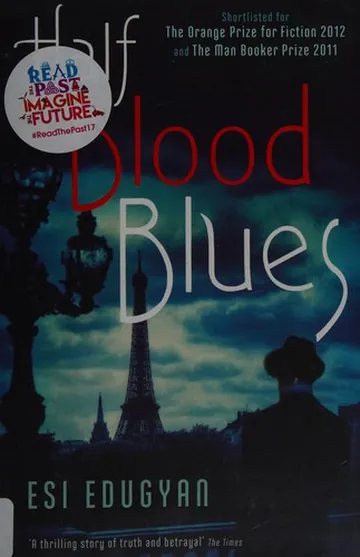
The first page of Half-Blood Blues
Chip told us not to go out. Said, don’t you boys tempt the devil. But it been one brawl of a night, I tell you, all of us still reeling from the rot – rot was cheap, see, the drink of French peasants, but it stayed like nails in you gut. Didn’t even look right, all mossy and black in the bottle. Like drinking swamp water.
See, we lay exhausted in the flat, sheets nailed over the windows. The sunrise so fierce it seeped through the gaps, dropped like cloth on our skin. Couple hours before, we was playing in some back-alley studio, trying to cut a record. A grim little room, more like a closet of ghosts than any joint for music, the cracked heaters lisping steam, empty bottles rolling all over the warped floor. Our cigarettes glowed like small holes in the dark, and that’s how I known we wasn’t buzzing, Hiero’s smoke not moving or nothing. The cig just sitting there in his mouth like he couldn’t hear his way clear. Everyone pacing about, listening between takes to the scrabble of rats in the wall. Restless as hell. Could be we wasn’t so rotten, but I at least felt off. Too nervous, too crazed, too busy watching the door. Forget the rot. Forget the studio’s seclusion. Nothing tore me out of myself. Take after take, I’d play sweating to the end of it only to have Hiero scratch the damn disc, toss it in the trash.
Continue reading
‘Just a damn braid of mistakes,’ Hiero kept muttering. ‘A damn braid of mistakes.’
‘We sound like royalty – after the mob got done with em,’ said Chip.
Coleman and I ain’t said nothing, our heads hanging tiredly.
But Hiero, wiping his horn with a blacked-up handkerchief, he turn and give Chip a look of pure spite. ‘Yeah, but, hell. Even at our worst we genius.’
Did that ever stun me, him saying this. For weeks the kid been going on and on about how dreadful we sound. He kept snatching up the discs, scratching the lacquer with a pocket knife, wrecking them. Yelling how there wasn’t nothing there. But there was something. Some seed of twisted beauty.
I didn’t mean to. But somehow when the kid turned his back I was sliding off my vest, taking the last disc – still delicate, the grooves still new – and folding the fabric round it. I glanced around, nervous, then tucked it into my basscase. The others was packing up their axes.
‘Where’s that last record at?’ said Hiero, frowning. He peered at the trash bin, at the damaged discs all in there.
‘It’s in there, buck,’ I said. ‘You didn’t want it, did you?’
He give me a sour look. ‘Ain’t no damn point. We ain’t never goin get this right.’
‘What you sayin, kid?’ said Chip, slurring his words. ‘You sayin we should give it up?’
The kid just shrugged.
We lined up the empty bottles along the wall, locked up real quiet, gone our separate routes back to Delilah’s flat. Curfew was on and Paris was grim, all clotted shadows and stale air. I made my quiet way along the alleys, dreading the sound of footsteps, till we met up again at the flat. Everyone but Coleman, of course, Coleman who was staying with his lady. We collapsed onto dirty couches under blackout curtains.
“A memorable evocation of the defiant thrill of jazz at a terrible time.”
Kirkus Reviews
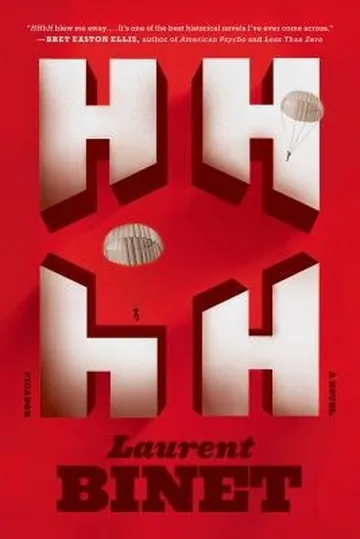
The first page of HHhH
Gabčík—that’s his name—really did exist. Lying alone on a little iron bed, did he hear, from outside, beyond the shutters of a darkened apartment, the unmistakable creaking of the Prague tramways? I want to believe so. I know Prague well, so I can imagine the tram’s number (but perhaps it’s changed?), its route, and the place where Gabčík waits, thinking and listening. We are at the corner of Vyšehradská and Trojická. The number 18 tram (or the number 22) has stopped in front of the Botanical Gardens. We are, most important, in 1942. In The Book of Laughter and Forgetting, Milan Kundera implies that he feels a bit ashamed at having to name his characters. And although this shame is hardly perceptible in his novels, which are full of Tomášes, Tominas, and Terezas, we can intuit the obvious meaning: what could be more vulgar than to arbitrarily give—from a childish desire for verisimilitude or, at best, mere convenience—an invented name to an invented character? In my opinion, Kundera should have gone further: what could be more vulgar than an invented character?
Continue reading
So, Gabčík existed, and it was to this name that he answered (although not always). His story is as true as it is extraordinary. He and his comrades are, in my eyes, the authors of one of the greatest acts of resistance in human history, and without doubt the greatest of the Second World War. For a long time I have wanted to pay tribute to him. For a long time I have seen him, lying in his little room—shutters closed, window open—listening to the creak of the tram (going which way? I don’t know) that stops outside the Botanical Gardens. But if I put this image on paper, as I’m sneakily doing now, that won’t necessarily pay tribute to him. I am reducing this man to the ranks of a vulgar character and his actions to literature: an ignominious transformation, but what else can I do?
I don’t want to drag this vision around with me all my life without having tried, at least, to give it some substance. I just hope that, however bright and blinding the veneer of fiction that covers this fabulous story, you will still be able to see through it to the historical reality that lies behind.
I don’t remember exactly when my father first told me this story, but I can see him now, in my public-housing bedroom, pronouncing the words “partisans,” “Czechoslovaks,” perhaps “operation,” certainly “assassinate,” and then this date: “1942.” I’d found History of the Gestapo by Jacques Delarue on his bookshelves, and started to read it. Seeing me with this book in my hands, my father had made some passing remarks: he’d mentioned Himmler, the leader of the SS, and then his right-hand man, Heydrich, the Protector of Bohemia and Moravia. And he’d told me of a Czechoslovak commando sent by London, and an assassination attempt. He didn’t know the details—and I had no reason to ask for them at the time, as this historic event hadn’t yet taken hold of my imagination. But I had sensed in him that slight excitement he always gets when recounting something he finds striking. I don’t think he was really aware of the importance he gave this anecdote. When I told him recently of my intention to write a book on the subject, all I sensed was polite curiosity without a trace of any particular emotion.
“Binet’s tour de force debut…”
Publishers Weekly

The first page of The Underground Library
Hurry, Sofie! Her sister’s voice floated through the open door, echoing past the bookcases lining the walls. It reached her as Sofie sat in a world of her own, lounging in the window seat in her father’s library, her favorite spot in the house. A book lay open in her hands, but her eyes were gazing out to the pale pink softness of the cherry blossom petals fluttering down from the tree on the street below.
There you are! Rachel hurried into the library, and Sofie could hear the tenderness in her elder sister’s voice as she crossed the room. I knew I’d find you in here. She smiled gently and rested a hand on Sofie’s arm, and Sofie tried to imprint it into her memory, the essence of their nineteen years together—her entire childhood, and the only place she had ever known.
“I’ve decided not to go.” Sofie trained her eyes on the page, trying to blot out reality. “You can tell Papa.”
Continue reading
But Rachel’s hand remained on her arm, her voice calm. “You know you have to go, Sofie. Think of Papa. He worries about you, and we’ll follow you there very soon.” She fixed Sofie with her firm smile, as if it were all agreed and there was nothing more to say. “We’ll be together again before you know it.”
Three years older, Rachel had always been the leader, serious and strong. Sofie, ever the youngest, had been the dreamy one with her head in a book. “Why can’t you go in my place? You’re far better suited for this than I am.”
“I’m sorry, Sofie.” She sat down beside her. “This job, the visa, they’re in your name. I can’t take your place, and even if I could, I wouldn’t. I want you to be safe, and right now, Britain is one of the safest places in Europe.” Rachel put an arm around her, and Sofie slumped into her with resignation, knowing that she was right, as usual. Ever since their mother’s death ten years ago, Rachel had taken on much of the responsibility of their family. Sofie had been partially raised by her, not that she would admit it. As a result, Rachel was the person she always turned to when she didn’t know what to do.
Pulling away, Sofie crushed her fists into her eyes with frustration. “But if they hadn’t canceled your job, we’d have been leaving for London together. At least we would have each other.”
“I know that it’s daunting to go alone, Sofie, but a job will come up for me soon. I’ve been going to the British Embassy every day to check the advertisements and apply for posts. Yesterday there were two, one for a housekeeper and another for a cook—although I would have to learn some of that bland British cooking for the job.” Rachel laughed, trying to make light of it, but they both knew how dire things were. Britain was the only place in Europe still offering visas to Jews; every other country was too scared of having a deluge of refugees, too scared of what that could mean in the coming war.
But the British visa came with a catch: you could only apply for one if you had already secured a job contract for domestic work. There was a shortage of servants in Britain, so the British humanitarian groups pressing to help Jews had finally struck a deal with the government: They would let Jews into the country if they were to fill a vacant servant’s position.
“But it’s not so easy anymore,” Sofie said in despair. “Scores of people are swarming to the British Embassy every day to apply for only one or two new positions. Everyone I know is trying to get a visa. What will we do if you’re not picked?”
“Three plucky heroines are connected by a love of books that helps them cope through the London Blitz.”
Kirkus Reviews
Questions
Quick answers
Which of these is true history?
HHhH. Binet tells the real story of the 1942 mission to kill Reinhard Heydrich in Prague, along with his own struggle to write it.